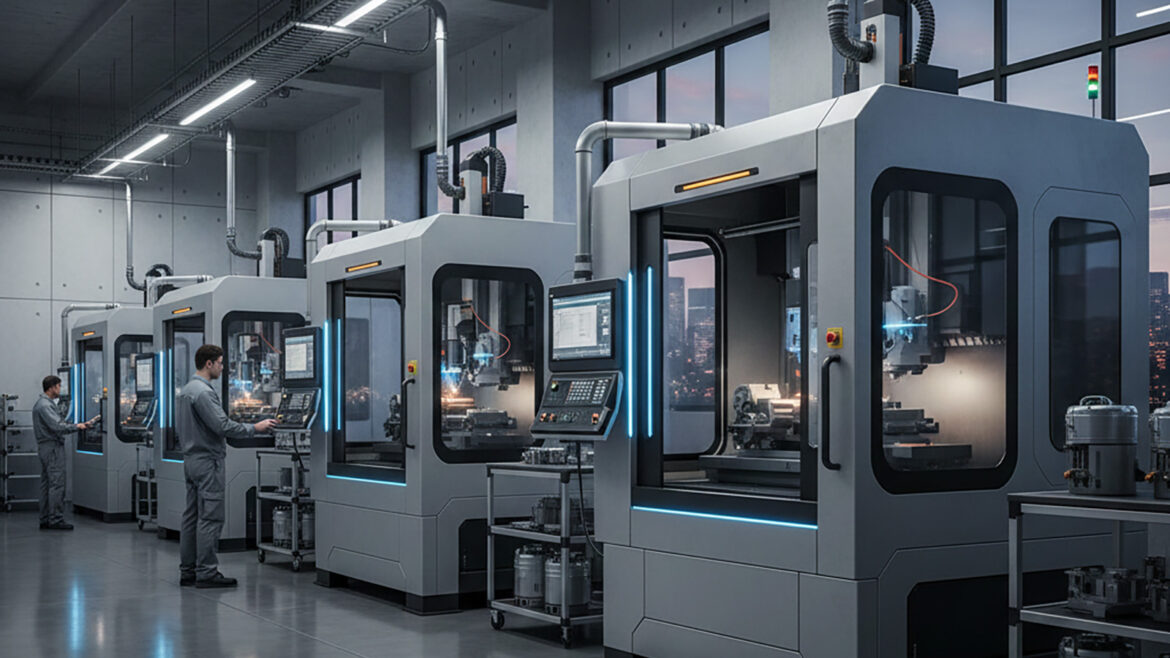
For decades, CNC machines were judged by familiar criteria: spindle speed, rigidity, accuracy, and how well they could remove material. Software existed, of course, but it was mostly a supporting actor—something you configured once and rarely thought about again.
That balance has changed.
Today, when manufacturers compare CNC machines, the conversation often shifts away from pure mechanics and toward questions that would have sounded out of place twenty years ago. How easy is the interface? Can it integrate with our ERP system? Does it support remote monitoring? How often does the software get updated?
In many workshops, the machine itself is no longer just a piece of equipment. It is becoming a software platform.
From hardware dominance to digital dependency
Traditional CNC buying decisions were straightforward. You chose a machine based on cutting performance, reliability, and price. Software mattered, but it rarely influenced long-term strategy.
Modern production environments are different. Machines are expected to communicate, adapt, and generate data. A CNC that cannot share information with planning systems, maintenance tools, or quality control software quickly becomes a bottleneck, no matter how solid its mechanical design may be.
This is not about replacing hardware importance. Precision still matters. Rigidity still matters. But hardware alone is no longer enough to stay competitive.
Software has become the layer that connects machines to the rest of the factory.
CNC machines as data producers
Every modern CNC machine generates enormous amounts of data: spindle load, vibration, temperature, tool wear, cycle times, alarms, and more. In the past, most of this information stayed inside the control, invisible to decision-makers.
Now, that data is increasingly exposed, analyzed, and used.
Manufacturers are using CNC data to:
- Detect inefficiencies in machining cycles
- Identify early signs of tool or spindle problems
- Compare performance across machines, shifts, or plants
- Support predictive maintenance strategies
A CNC machine that cannot provide clean, accessible data limits what the business can do with it. In this sense, the value of the machine extends far beyond cutting metal. It lies in how well it communicates.
The control is no longer just a control
CNC controls have evolved dramatically. Modern interfaces resemble industrial operating systems more than traditional control panels. Touchscreens, customizable dashboards, user profiles, and software updates are becoming standard.
This shift changes how people interact with machines.
Operators no longer just execute programs. They monitor performance, respond to system feedback, and work with digital tools that guide decisions in real time. Engineers and managers gain visibility into production without standing next to the machine.
In many cases, the control becomes the primary interface between people, machines, and data. That is a defining characteristic of a software platform.
Integration matters more than raw performance
One of the clearest signs of this transition is integration.
Manufacturers increasingly expect CNC machines to connect with:
- MES and ERP systems
- Tool management software
- Quality and inspection systems
- Maintenance and asset management platforms
A machine that operates in isolation creates friction. Data must be entered manually. Decisions are delayed. Errors increase.
By contrast, CNC machines designed with open interfaces and software integration in mind become part of a connected production ecosystem. They support faster planning, better traceability, and more informed decision-making.
For many companies, this integration capability becomes a stronger purchasing argument than marginal differences in cutting speed.
Software updates extend machine life
In the past, a CNC machine’s capabilities were largely fixed at the moment of installation. Improvements required hardware upgrades or complete replacement.
Software-driven machines behave differently.
New features, performance optimizations, security improvements, and compatibility updates can be delivered through software. This extends the useful life of the machine and reduces the risk of technological obsolescence.
For small and mid-sized manufacturers, this matters greatly. A machine that evolves through software updates protects the investment far better than one that remains static.
In practical terms, the CNC becomes less like a fixed asset and more like a continuously improving system.
The human factor: skills over muscle memory
As CNC machines become software platforms, the required skills also change.
Operators increasingly work with interfaces, data, and digital workflows. Understanding how to interpret machine feedback becomes as important as manual setup experience. Troubleshooting often starts with software diagnostics before any mechanical intervention.
This shift does not remove the need for craftsmanship. It changes where expertise is applied.
Companies that recognize this early invest not only in machines, but also in training. They treat software literacy as a production skill, not an IT problem.
Those that ignore it often struggle to unlock the full value of their equipment.
Maintenance is becoming predictive, not reactive
One of the strongest drivers behind this transformation is maintenance.
Software-enabled CNC machines support condition monitoring and predictive maintenance strategies. Instead of reacting to breakdowns, manufacturers can schedule interventions based on real machine behavior.
This reduces unplanned downtime, improves spare parts planning, and stabilizes production schedules.
Again, the mechanical quality of the machine remains critical. But without software capable of analyzing and communicating machine health, these benefits are difficult to achieve.
Predictive maintenance is not a feature you bolt on. It is a function of the machine’s software architecture.
Why this matters beyond technology
The shift toward software-centric CNC machines is not just a technical trend. It affects business decisions.
When machines become platforms:
- Purchasing decisions focus on long-term ecosystem compatibility
- Vendor relationships become ongoing partnerships
- Data ownership and cybersecurity gain importance
- ROI calculations include software evolution, not just depreciation
Manufacturers who understand this change tend to make more resilient investments. They choose machines that fit into a digital strategy, even if that strategy is still evolving.
Those who do not often find themselves locked into systems that are difficult to scale or integrate.
Not all CNC machines are equal platforms
It is important to be clear: not every CNC machine marketed as “digital” truly functions as a software platform.
Some offer limited connectivity with closed systems. Others provide data, but in formats that are difficult to use. True platform-oriented machines prioritize openness, integration, and long-term software support.
For buyers, this means asking different questions:
- How often is the software updated?
- Can we access machine data easily?
- Does the control integrate with third-party systems?
- What happens five or ten years from now?
These questions matter as much as technical specifications.
Looking ahead
CNC machines will continue to cut metal. That will never change.
What is changing is everything around that process. Software is becoming the layer that defines flexibility, efficiency, and competitiveness. Machines that cannot evolve digitally risk becoming isolated islands in an increasingly connected factory.
The manufacturers who recognize this are already adjusting how they select, deploy, and manage CNC equipment.
They are not buying machines alone. They are adopting platforms.
Sources & Further Reading
- Smart Manufacturing & CNC Integration
- CNC Connectivity & Real-Time Data
- MTConnect Protocol for Machine Connectivity
- Smart CNC Data & Digital Twins
- Industry 4.0 & CNC Transformation