How manufacturers worldwide are responding to a structural talent gap – and why automation has become a pragmatic necessity.
In This Article
The global workforce shortage is no longer just a hiring headache; it is the primary force driving industrial innovation today. According to the latest report by Deloitte and The Manufacturing Institute, the U.S. manufacturing sector alone may face over 2.1 million unfilled positions by 2030, driven by an aging workforce, a lack of qualified candidates, and shifting expectations among younger professionals. Similar patterns are emerging across Europe and Asia, where manufacturers report record‑high difficulty in hiring operators, technicians, and engineers.
Source: Deloitte & The Manufacturing Institute, “2021 Manufacturing Talent Study”.
This structural gap is changing not only how factories operate but also how they invest. Instead of viewing automation as a long‑term vision, many companies now adopt it as an immediate response – a way to maintain output, reduce errors, and compensate for roles that simply cannot be filled.
Automation: The New Face of Industrial Innovation
Conversations with production managers across regions reveal a consistent theme: automation is not about replacing people, but about keeping production running in an environment where labor is increasingly scarce.
Siemens reports a significant rise in demand for digitalization and robotics solutions from small and medium‑sized manufacturers – companies traditionally slower to adopt new technologies. ABB Robotics notes that its fastest‑growing customer segment consists of businesses deploying a robot for the first time, not to cut costs but to fill persistent vacancies.
This surge in demand highlights how industrial innovation is shifting from a luxury for giants to a survival necessity for small and medium-sized enterprises.
Sources:
Human Stories Behind the Numbers
To understand how this shift looks on the ground, consider the experience of Mariko Tanaka, a production team lead at an electronics plant in Nagoya, Japan. In an interview for the Japan Industrial Workforce Association annual report, she describes the past few years as a turning point:
What has been the biggest challenge recently? “Finding people. Not engineers – operators. Roles that used to be filled within days now stay open for months.”
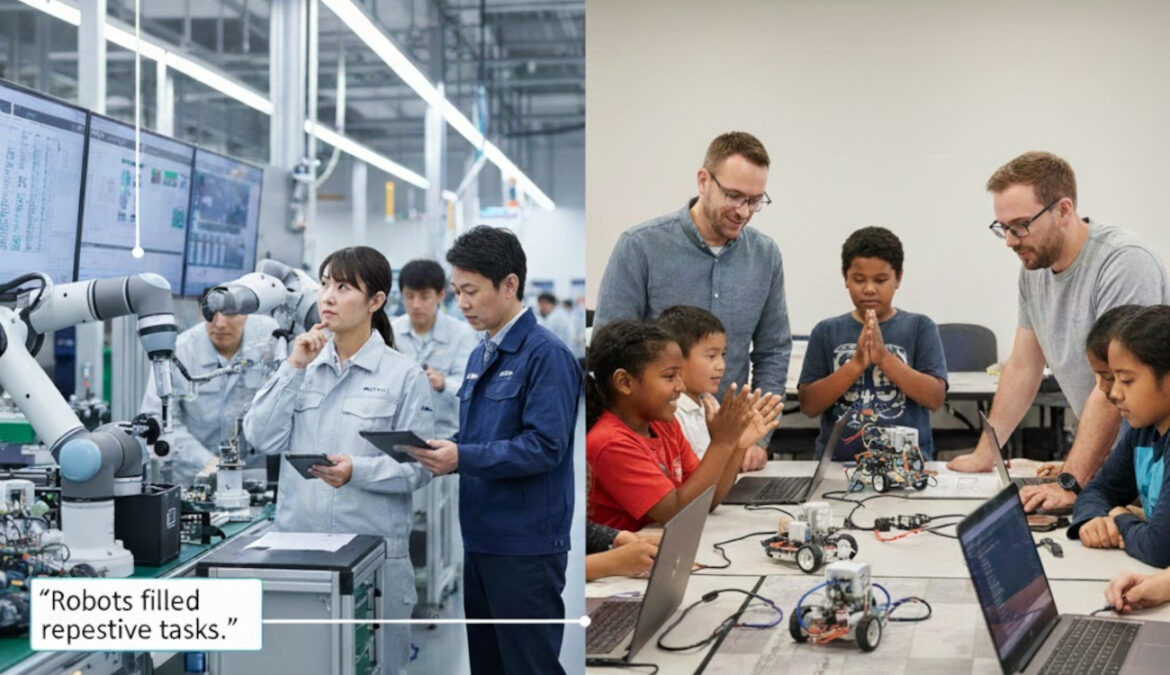
How did you respond? “We introduced collaborative robots. Not to reduce headcount, but to meet demand. The robots took over repetitive tasks, and our staff moved into monitoring and setup.”
Training the Workforce of the Future
Technology alone cannot solve the talent shortage. Many companies are investing in training, school partnerships, and reskilling programs. One of the most illustrative examples comes from the United States.
To understand how this works in practice, we look at the experience of Jason Miller, a volunteer mentor at a Code Club in Oregon. In an interview for the Raspberry Pi Foundation’s annual report, he shares his observations on how students build their digital literacy:
What’s the biggest change you see in kids? “Confidence. They walk in thinking programming is some kind of magic. A few weeks later, they’re arguing about how to improve the logic in a game they built themselves.”
What motivates them the most? “Projects. When they see a robot move because of something they wrote, it clicks. They realize technology isn’t a mystery – it’s something they can shape.”
Source: Raspberry Pi Foundation, Annual Report 2023.
As we explored in our previous feature on digital literacy, initiatives like Code Club are essential. These programs won’t solve today’s shortages, but they help build a generation better prepared for tomorrow’s industrial roles.
True industrial innovation requires more than just robots; it demands a workforce with the digital literacy to manage them.
A Global Challenge With Local Consequences
Across Europe, Eurostat reports that 36% of manufacturing companies say labor shortages are limiting their production. In Germany, industry associations warn that the lack of skilled technicians could slow the adoption of green technologies. In South Korea, the government is funding automation programs for small manufacturers as a key part of their industrial innovation strategy.
Sources:
- Eurostat Industry Survey 2024
- German Mechanical Engineering Industry Association (VDMA) Report 2023
- Korea Ministry of SMEs and Startups, Automation Support Program 2023
Common Questions About Industrial Innovation
- How does workforce shortage impact industrial innovation? It forces companies to adopt automation not just for speed, but for basic operational survival.
- What is the role of digital literacy in industrial innovation? It ensures that the current workforce can transition from manual tasks to managing advanced robotic systems.
Conclusion: Innovation Driven by Necessity
The global labor shortage is not a temporary disruption but a structural shift that will shape industrial policy for the next decade. Companies that adapt successfully tend to combine:
- Automation that compensates for missing personnel
- Training that builds new skills
- Partnerships with educational organizations
- Flexible work models
This is not a futuristic vision. It is a pragmatic response to a reality affecting factories from Detroit to Shenzhen.