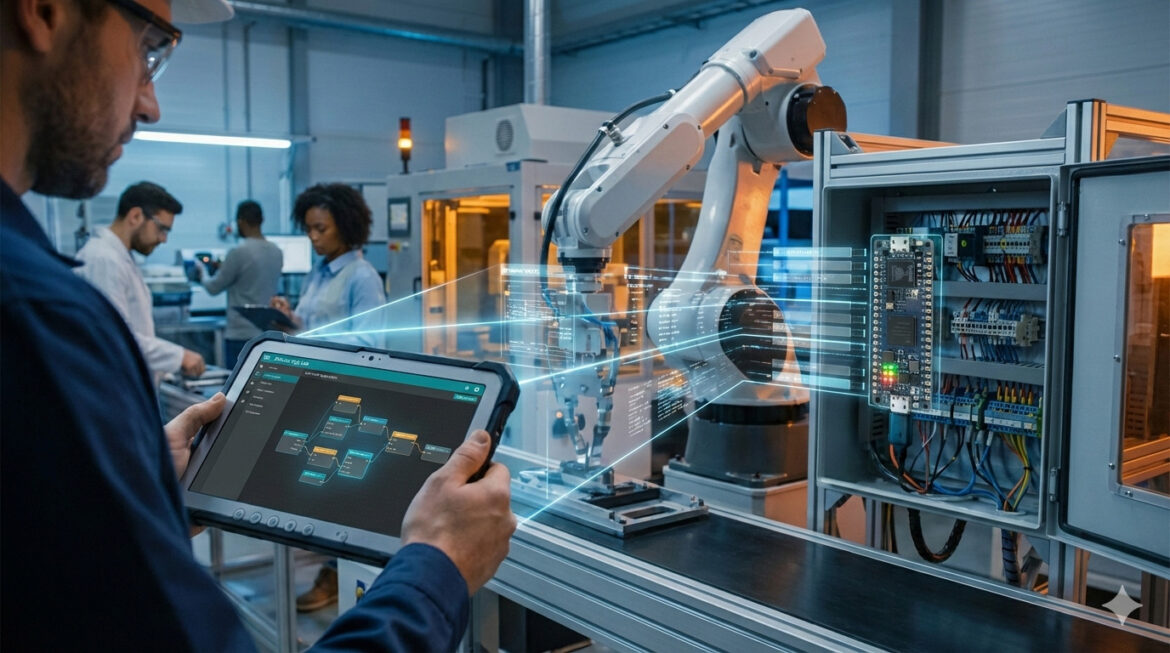
The industrial world is entering a new phase – one where innovation no longer comes only from automation giants and multi‑million‑euro projects. Increasingly, it’s driven by engineers, technicians, and small teams who now have tools that let them build solutions in hours instead of months. One of the clearest signs of this shift is the latest release of Arduino App Lab 2026 – a platform that turns the low‑code approach into a real engine for industrial innovation in 2026.
This isn’t just another software update. It’s a low‑code revolution making its way directly onto the factory floor.
In this deep dive, we explore why Arduino App Lab 2026 is becoming the go-to standard for industrial edge computing.
In This Article
The Rise of Industrial Low-Code: Arduino App Lab 2026
Low‑code and no‑code platforms have been popular in corporate IT for years, but manufacturing has traditionally lagged behind. Industrial processes are complex, safety‑critical, and require high reliability – not exactly the environment where drag‑and‑drop tools were expected to thrive.
But 2026 is the year low‑code finally enters the factory – not as an experiment, but as a practical tool for accelerating innovation.
Arduino App Lab is exactly that kind of tool.
What the New Arduino App Lab Actually Is
The new App Lab release was built with a clear mission: to let engineers create industrial applications without writing complex code.
The platform offers:
- a visual interface for building applications
- ready‑made UI components
- integration with Arduino Cloud
- support for industrial communication protocols
- native compatibility with Arduino Pro hardware
- fast deployment to edge devices
In short: App Lab turns complex industrial development into something accessible.
What’s New in the 2026 Release (Real Technical Details)
The Arduino App Lab 2026 edition introduces several upgrades that bridge the gap between prototyping and factory-grade deployment.
1) Support for Industrial Protocols
App Lab 2026 now supports:
- Modbus TCP/RTU
- MQTT
- CAN bus (via compatible modules)
- OPC UA (via extensions)
And here’s the important part: OPC UA is a genuine game changer.
It allows Arduino‑based systems to communicate with high‑end industrial equipment from Siemens, Rockwell, Beckhoff, and others – something that was previously impossible without custom middleware. This single feature elevates Arduino from “prototyping hardware” to a legitimate player in industrial connectivity.
To see these technical upgrades in action, check out this deep-dive video. It offers a visual walkthrough of the Arduino App Lab 2026 interface, showcasing how the new ‘Bricks’ and the Bridge system simplify complex industrial automation tasks:
2) Deep Integration with Arduino Pro Hardware
App Lab now works natively with key devices from the Arduino Pro line:
| Hardware Device | Key Industrial Feature | Primary Use Case |
| Portenta X8 | 8-core, Linux, Docker | Edge AI & High-performance computing |
| Opta PLC | IEC 61131-3, Modbus | Small automation & Retrofitting |
| Nicla Sense ME | Bosch BME688 Sensor | Predictive Maintenance |
Together, these devices turn App Lab into a full industrial IoT platform, not just a prototyping tool.
3) New Industrial App Templates
Ready‑to‑use templates for:
- machine monitoring
- energy management
- production parameter tracking
- predictive maintenance
- environmental control
Engineers can start a project in minutes.
4) Cloud‑Based Dashboards
App Lab 2026 allows users to create:
- dashboards
- alerts
- reports
- historical data views
…all without writing code.
5) Expanded AI Features (with Real Performance Metrics)
The platform now includes:
- anomaly detection
- basic predictive analytics
- automated recommendations
And thanks to the Portenta X8’s edge capabilities:
Edge AI inference typically runs with sub‑10 ms latency, which is critical for vibration analysis, anomaly detection, and closed‑loop control.
This is the kind of technical precision industrial engineers expect – and App Lab now delivers it.
Security in Arduino App Lab 2026: The Question Every IT Team Will Ask
Low‑code in an industrial environment often raises eyebrows — especially from IT and cybersecurity teams. Arduino App Lab 2026 addresses this with several concrete measures:
- Encrypted TLS 1.3 communication between devices and the cloud
- Isolated Docker containers on the Portenta X8 for safe execution
- ISO/IEC 27001‑certified cloud infrastructure
- Role‑based access control (RBAC) for deployment and editing
- Secure OTA updates with cryptographic integrity checks
This combination makes App Lab suitable even for environments with strict IT/OT governance. Data transmission security is ensured by protocols using 256-bit AES encryption, the industry standard for protecting sensitive industrial telemetry, making unauthorized access practically impossible.
One of the core pillars of Arduino App Lab 2026 is the zero-trust architecture, ensuring that every edge deployment is secure by default.
Bridging the OT–IT Divide
One of the biggest challenges in Industry 4.0 is the disconnect between OT (Operational Technology) and IT. App Lab directly addresses this:
- OT engineers can build logic and interfaces visually
- IT teams maintain control over networking, security, and deployment
- Both sides work on the same platform without stepping on each other
This alignment is rare – and extremely valuable.
Why This Matters for Manufacturing
Industrial companies – especially SMEs – often lack:
- large IT teams
- in‑house developers
- budgets for expensive MES or IoT platforms
- time for long deployment cycles
But they urgently need:
- automation
- monitoring
- connectivity
- optimization
- fast solutions
This is exactly where a low‑code tool like App Lab makes a massive difference.
Low‑Cost Innovation: The New Industrial Driver
One of the biggest shifts in 2026 is that innovation no longer depends on expensive systems. It now comes from:
- affordable sensors
- compact industrial controllers
- cloud services
- low‑code tools
- open‑source ecosystems
Arduino sits right at the center of this movement.
This is the democratization of industrial innovation.
Real Industrial Use Cases for App Lab
From the factory floor to the energy grid, here is how engineers are implementing Arduino App Lab 2026 in real-world scenarios:
1) Real‑Time Machine Monitoring
Sensors + App Lab = a working dashboard in minutes.
2) Predictive Maintenance
AI‑based alerts for vibration, temperature, or performance anomalies.
3) Energy Management
Tracking consumption, optimizing loads, generating alerts.
4) Small Production Line Control
Operator interfaces without the need for full SCADA systems.
5) Quality Tracking
Collecting sensor data and visualizing trends.
Where This Leaves the Industry
Tools like App Lab are reshaping the industrial landscape:
- innovation cycles shrink dramatically
- development costs drop
- engineers gain more autonomy
- digitalization becomes accessible
- deployment becomes faster
- reliance on external developers decreases
For SMEs, this shift is transformative.
Low‑code is no longer a convenience – it’s becoming a competitive advantage.
The Bottom Line: Low‑Code Is Becoming the New Industrial Language
Arduino App Lab 2026 isn’t just a new version of a tool. It’s a signal – that the future of industrial development is faster, more accessible, and more flexible.
In a world where innovation speed defines competitiveness, low‑code platforms give manufacturers exactly what they’ve been missing:
- agility
- affordability
- speed
- independence
If 2025 was the year of experimentation, then 2026 is the year low‑code becomes an industrial standard.
As we look ahead, Arduino App Lab 2026 stands as a testament to the democratization of technology, where speed and reliability finally meet.
If you want to see more industrial innovation breakdowns like this, follow our Business & Innovation section.