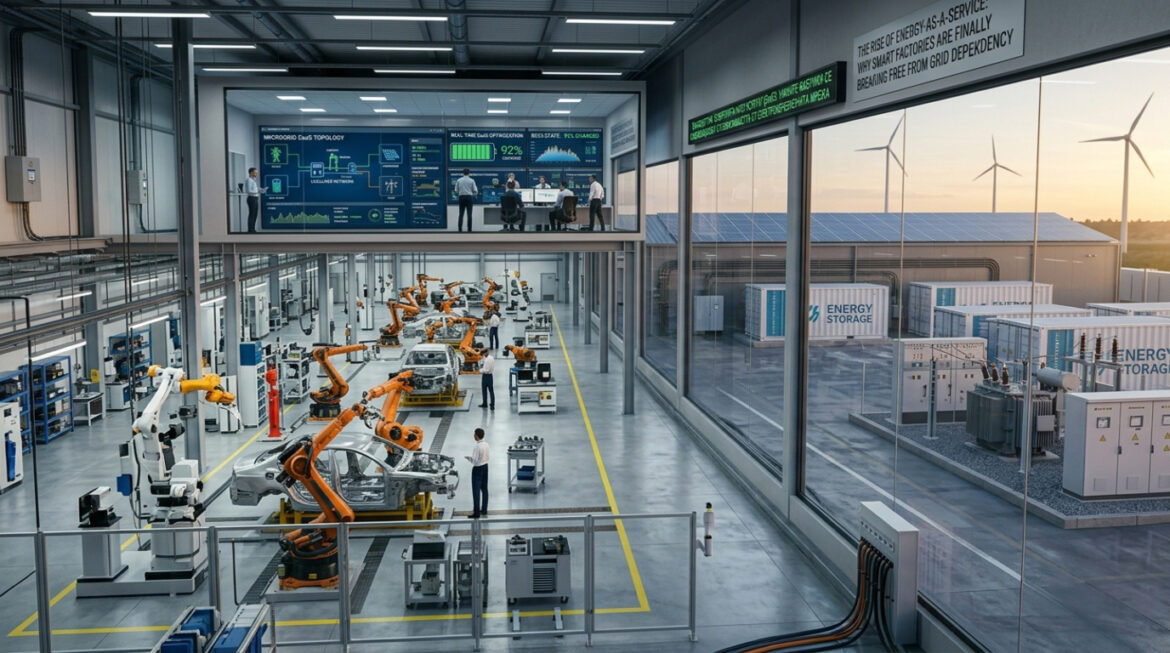
For many manufacturers, Energy-as-a-Service is becoming the solution to the biggest barrier to growth: electricity. While robotics and automation are critical, the real constraint has shifted to the limits of the electrical grid. Across industrial zones worldwide, companies face the same challenge: the local substation is at capacity, the grid is unstable, or the utility cannot deliver additional megawatts without years of upgrades.
This constraint has shaped industrial strategy for decades. But that era is ending. A new model is emerging – one that allows factories to scale without waiting for the grid to evolve. Energy-as-a-Service (EaaS) is redefining how industrial power is financed, generated, and managed. Instead of relying solely on the public grid, smart factories are becoming self-sufficient energy ecosystems, capable of producing, storing, and optimizing their own electricity.
This shift is not a technological novelty. It is a structural transformation in how modern industry operates.
In This Article
What Exactly Is Energy-as-a-Service?
Energy-as-a-Service is a subscription-based model in which a factory outsources its entire energy infrastructure to a specialized provider. Instead of investing millions in transformers, switchgear, solar arrays, battery storage, or microgrid controls, the manufacturer signs a long-term service agreement. The provider – companies such as Siemens, Schneider Electric, Honeywell, Engie, or Enel X – designs, finances, builds, and operates a complete onsite energy system.
The factory does not purchase equipment. It purchases guaranteed outcomes:
- Guaranteed power availability
- Guaranteed power quality
- Guaranteed cost predictability
- Guaranteed emissions reduction
This converts massive CAPEX into a stable OPEX model, freeing capital for automation, robotics, and production expansion.
In practice, an Energy-as-a-Service provider may deploy:
- Rooftop or ground-mounted solar
- Wind turbines where feasible
- Large-scale Battery Energy Storage Systems (BESS)
- Natural gas or hydrogen generators
- AI-driven microgrid controllers
- Power quality stabilizers
- EV charging infrastructure
The result is a resilient, self-balancing energy ecosystem – without the factory owning a single component.
The AI Brain Behind the Modern Microgrid
The real breakthrough behind Energy-as-a-Service is not the hardware. It’s the intelligence that orchestrates it.
Modern Energy Management Systems (EMS) use machine learning to predict, optimize, and balance energy flows across the entire facility. These systems function as a central nervous system, coordinating every second of the factory’s energy life.
This real-time optimization relies on high-speed industrial connectivity and 5G networks.
1. Peak Shaving
Industrial electricity bills often include “demand charges” – penalties for drawing too much power during peak hours. AI predicts when these peaks will occur and automatically switches the factory to stored battery power.
The result: significant reductions in energy costs, in some cases up to 50%.
2. Predictive Loading
The EMS synchronizes with the Manufacturing Execution System (MES). When a heavy CNC machine or laser welding robot is about to start, the AI pre‑shifts power from the BESS to prevent voltage dips that could shut down sensitive equipment.
3. Virtual Power Plant (VPP) Mode
When the factory generates more energy than it consumes – during weekends or periods of high solar output – the system sells excess electricity back to the grid.
A traditional cost center becomes a dynamic revenue stream.
Real-World Examples: EaaS in Action
This is not a theoretical model. Several global manufacturers are already using Energy-as-a-Service as a strategic advantage.
Schneider Electric – Walmart Distribution Centers (USA)
Schneider operates microgrids with BESS and solar installations across multiple Walmart logistics hubs. Results include:
- 30% lower energy costs
- Uninterrupted operations during grid disturbances
- Expansion without waiting for utility upgrades
Siemens – Automotive Manufacturing (Germany)
A major automaker needed an additional 12 MW for a new EV production line. The local grid could not supply it. Solution: an onsite microgrid with a 20 MWh BESS deployed under an Energy-as-a-Service model. Outcome: the expansion launched on schedule, without a single day of delay.
Honeywell – Chemical Processing Plants (India)
Chemical plants are extremely sensitive to voltage fluctuations. Honeywell’s AI-driven EMS eliminated 95% of voltage sags. Benefits included:
- Fewer production interruptions
- Reduced waste
- Improved safety
These examples demonstrate that Energy-as-a-Service is not an experiment – it is a proven industrial strategy.
Decoupling: Growth Without Grid Constraints
This is the most powerful strategic advantage of Energy-as-a-Service.
In many industrial zones, the grid is at its limit. Even a modest expansion – a new robotic cell, a new assembly line, a new printing press – can require:
- A new transformer
- Upgraded cabling
- Substation reinforcement
- Permits and engineering studies
- Months or years of waiting
EaaS bypasses this bottleneck entirely. The factory generates and manages its own energy.
This enables:
- Growth without constraints
- Expansions without delays
- Independence from aging infrastructure
- Faster deployment of Industry 4.0 technologies
In a world where speed defines competitiveness, Energy-as-a-Service becomes a growth accelerator.
Energy Security: The New Industrial Priority
Recent years have exposed the fragility of global energy supply chains. Conflicts, blocked shipping routes, refinery strikes, and natural disasters have disrupted fuel deliveries and caused sudden price spikes.
Factories that rely solely on the grid are vulnerable. Factories using Energy-as-a-Service are not.
EaaS provides:
- Local generation
- Local storage
- Local control
- Predictable costs
- Uninterrupted operations
It is industrial-scale energy independence – and a strategic shield against global volatility.
A New Industrial Freedom
The competitive edge in manufacturing is no longer defined only by automation, robotics, or production speed. It is defined by energy strategy. Energy-as-a-Service transforms factories into autonomous energy ecosystems – more flexible, more resilient, and far less dependent on unstable grid infrastructure.
This model is not simply a new type of utility contract. It is a new form of industrial freedom.
Factories that embrace it today will be the ones setting the pace tomorrow.