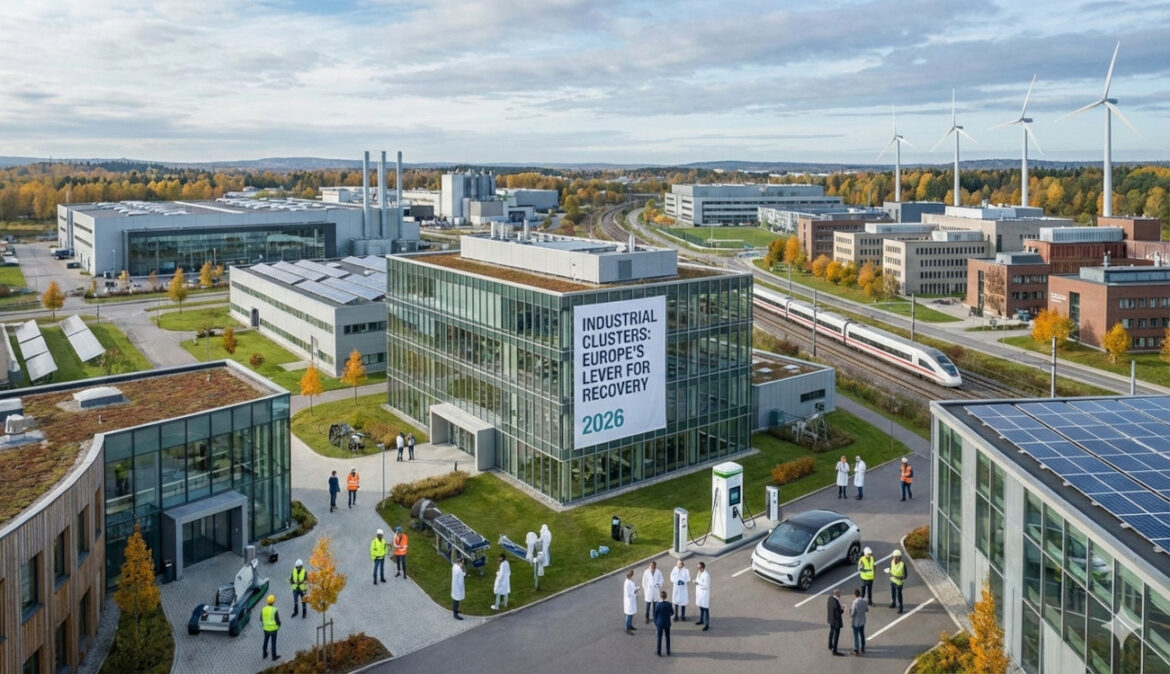
Industrial clusters are emerging as Europe’s most powerful lever for economic recovery in 2026. As global competition intensifies – from Asia’s scale to the United States’ subsidy‑driven industrial push – Europe needs mechanisms that amplify productivity, accelerate innovation and anchor strategic industries. Industrial clusters offer exactly that: concentrated ecosystems where companies, suppliers, universities and infrastructure reinforce each other and create advantages that individual factories cannot achieve alone.
In a year defined by supply‑chain restructuring, labour shortages and rising geopolitical pressure, industrial clusters are becoming the backbone of Europe’s new industrial strategy. They reduce risk, increase resilience and enable regions to compete globally even without the cost advantages of larger economies.
In This Article
Why Industrial Clusters Matter in 2026
Industrial clusters are becoming essential to Europe’s competitiveness because they solve several structural problems that individual factories cannot address on their own. In a global environment shaped by high energy prices, fragmented supply chains and intense competition from Asia and the United States, industrial clusters create concentrated ecosystems where productivity, innovation and talent reinforce each other.
A modern industrial cluster brings together manufacturers, suppliers, logistics providers, research institutions and public infrastructure within a single region. This density reduces transaction costs, accelerates technology transfer and enables companies to scale faster than they could in isolation. For Europe – a continent with limited labour pools and high operating costs – industrial clusters offer a way to achieve efficiency without relying on cheap labour or massive production zones.
In 2026, as Europe seeks to rebuild growth and strengthen strategic autonomy, industrial clusters are emerging as one of the few tools capable of delivering both resilience and competitiveness at the same time.
How Industrial Clusters Work in Practice
Industrial clusters function as tightly connected ecosystems where proximity creates advantages that no single company can replicate on its own. Their strength comes from density: manufacturers, suppliers, logistics providers, research centres and training institutions operate within the same geographic area, forming a network that accelerates production and innovation.
In a typical industrial cluster, companies benefit from shared infrastructure, specialised labour pools and faster access to components and services. Knowledge flows more easily between firms, universities and technology centres, enabling rapid adoption of new processes and technologies. This environment reduces operational risk, shortens development cycles and increases the overall competitiveness of the region.
For Europe, where high labour costs and fragmented markets often limit scale, industrial clusters provide a structural advantage. They allow companies to operate efficiently without relying on low‑cost labour or massive production zones. Instead, competitiveness comes from coordination, specialisation and the ability to innovate faster than global competitors.
Why Industrial Clusters Outperform Standalone Factories
Industrial clusters consistently outperform standalone factories because they replace isolated production with coordinated ecosystems. When companies operate alone, they face higher transaction costs, slower innovation cycles and limited access to specialised suppliers or talent. Within industrial clusters, these constraints disappear. This shared talent pool is a critical answer to the current industrial innovation and workforce shortage, providing a structural solution to labour constraints that individual firms cannot solve alone.
Proximity allows firms to share infrastructure, exchange knowledge and respond quickly to market or supply‑chain disruptions. A supplier located 20 minutes away can adjust production in days, not weeks. A university lab inside the cluster can support rapid prototyping and technology transfer. A shared talent pool reduces hiring bottlenecks and strengthens workforce mobility across the region.
This concentration of capabilities creates a multiplier effect: each company becomes more productive because the entire cluster is more productive. For Europe – where scale is limited and labour shortages are structural – industrial clusters offer a way to achieve competitiveness through coordination rather than size. They enable regions to innovate faster, operate more efficiently and attract investment that would otherwise flow to larger, lower‑cost markets.
European Examples: Where Industrial Clusters Already Deliver Results
Europe already hosts some of the world’s most advanced industrial clusters, each demonstrating how concentrated ecosystems can outperform traditional industrial models. These regions show that industrial clusters are not an abstract policy concept but a proven mechanism for competitiveness, innovation and resilience.
Brainport Eindhoven (Netherlands) – Deep‑Tech and Semiconductor Leadership
Anchored by ASML and a dense network of high‑tech suppliers, Brainport Eindhoven is one of Europe’s strongest industrial clusters. Its tight integration enables rapid innovation cycles, shared R&D infrastructure and a level of specialisation that would be impossible for isolated companies.
Battery Valley, Northern Sweden – Europe’s Energy‑Storage Hub
Northern Sweden has rapidly developed into a leading European cluster for battery production and clean‑energy technologies. Companies like Northvolt, supported by renewable energy infrastructure and coordinated public‑private investment, have transformed the region into a competitive alternative to Asian battery ecosystems.
Grenoble (France) – Microelectronics and Advanced Materials
Grenoble’s industrial cluster brings together semiconductor manufacturers, materials science labs, universities and specialised suppliers. Decades of coordinated investment have created a region capable of sustaining high‑value manufacturing in a high‑cost environment.
Bavaria (Germany) – Automotive and Advanced Manufacturing
Bavaria’s automotive and engineering cluster remains one of Europe’s most productive industrial ecosystems. With OEMs, Tier‑1 suppliers, robotics companies and applied‑research institutes operating in close proximity, the region maintains global competitiveness despite rising costs.
Why Industrial Clusters Matter for SMEs and Startups
Industrial clusters are especially powerful for small and medium‑sized enterprises – the segment that forms the backbone of Europe’s industrial economy. While large corporations benefit from scale and established supply chains, SMEs often struggle with limited resources, higher operational risks and restricted access to talent or specialised infrastructure. Industrial clusters directly address these challenges.
Within an industrial cluster, SMEs gain immediate access to nearby customers, suppliers and technical partners. A startup developing a new component or software tool can test, iterate and deliver faster because its potential clients are located within the same ecosystem. Shared laboratories, testing facilities and logistics services reduce the cost of early‑stage development, while proximity to universities and research centres accelerates technology transfer.
Through these networks, even the smallest participants can adopt high-level strategies such as AI predictive maintenance for small factories, turning technical barriers into a shared competitive advantage.
Industrial clusters also create a more stable environment for SMEs by reducing dependency on distant suppliers and volatile global supply chains. When a small company operates inside a cluster, it benefits from a dense network of partners that can support rapid scaling or help absorb shocks. This makes survival more likely – and growth more achievable – than for SMEs operating in isolation.
For Europe, where SMEs represent more than 99% of all businesses, the ability of industrial clusters to nurture and scale smaller firms is a decisive advantage. Clusters transform SMEs from vulnerable actors into engines of innovation and regional competitiveness.
The Role of Funding and Public‑Private Partnerships in 2026
Industrial clusters do not emerge organically; they require sustained investment, coordinated planning and long‑term commitment. In 2026, European funding instruments and public‑private partnerships (PPP) play a central role in enabling these ecosystems to grow and compete globally.
European programmes such as InvestEU, Horizon Europe and the Innovation Fund provide critical financing for infrastructure, R&D facilities, clean‑energy projects and workforce development. These funds reduce the financial burden on individual companies – especially SMEs – by financing the shared assets that define successful clusters. Furthermore, such investments are essential for scaling the technologies needed for net-zero production in 2026 through automation, effectively aligning regional growth with Europe’s broader environmental targets.
Public‑private partnerships amplify this effect. Governments invest in transport links, energy systems and digital infrastructure, while industry contributes capital, technology and operational expertise. Universities and research institutes add scientific depth and talent pipelines. This coordinated model has already proven effective in regions like Brainport Eindhoven and Grenoble, where decades of joint investment have created globally competitive industrial clusters.
In 2026, as Europe seeks to accelerate its economic recovery, the combination of EU funding and PPP frameworks becomes a strategic tool. It allows regions to build the infrastructure and capabilities needed for industrial clusters to thrive – and ensures that both large companies and SMEs can benefit from the resulting ecosystem.
Risks and Mitigation Strategies in 2026
The success of industrial clusters is not automatic. As these ecosystems expand, they face structural risks that can undermine their long‑term competitiveness if left unaddressed. In 2026, several challenges require coordinated action from regional authorities, industry and policymakers.
Regional Overheating
High concentrations of companies and talent can drive rapid increases in housing prices, create shortages of affordable accommodation and overload local transport networks – trends already visible in Eindhoven and Munich.
Mitigation: Integrated regional planning that expands public transport, accelerates housing development and aligns urban growth with industrial expansion.
Intellectual “Cannibalisation”
In dense ecosystems, large companies may unintentionally absorb talent, ideas or early‑stage innovations from startups, limiting the independence and growth potential of smaller firms.
Mitigation: Clear frameworks for intellectual‑property protection, transparent collaboration models and ethical mobility guidelines within the cluster.
Technological Lock‑In
Clusters that become overly specialised in a single technology – such as lithium‑ion batteries – risk losing competitiveness if disruptive alternatives emerge.
Mitigation: Strong links to universities and fundamental research institutions, ensuring continuous horizon scanning and diversification into adjacent technologies.
Industrial clusters thrive when they balance concentration with flexibility. Addressing these risks early allows regions to preserve the dynamism that makes clusters powerful engines of innovation and economic growth.
How Industrial Clusters Can Drive Europe’s Economic Recovery in 2026
Industrial clusters can accelerate Europe’s economic recovery by concentrating investment, talent and innovation in regions capable of generating high‑value output. They create faster job growth than isolated factories, support the development of specialised SMEs and strengthen local supply chains. This reduces Europe’s dependence on external manufacturing hubs and increases resilience against geopolitical shocks.
Clusters also attract private capital more effectively than dispersed industrial projects. Investors prefer regions where infrastructure, suppliers and talent are already in place – and industrial clusters provide exactly that. For governments, supporting clusters is more efficient than subsidising individual factories, because the benefits multiply across the entire ecosystem.
In 2026, as Europe seeks to rebuild growth, industrial clusters offer a path to higher productivity, stronger regional economies and greater strategic autonomy.
A Different Kind of Industrial Future
Europe cannot compete with Asia on cost or with the United States on subsidies. But it can compete through architecture – by building dense, high‑performance industrial clusters that amplify innovation, reduce risk and accelerate growth. Industrial clusters are not a return to the past; they are Europe’s most realistic path to a resilient industrial future.
If Europe can scale these ecosystems in time, industrial clusters may become the continent’s most powerful tool for economic recovery in 2026 and beyond.
For those looking to witness these ecosystems firsthand, major international stages like Hannover Messe 2026 will serve as the ultimate proving ground for the cluster-driven model of recovery.