Ask any controls engineer in 2026 what changed the most in their daily work, and you’ll hear a similar answer:
“We’re running more logic at the edge now.”
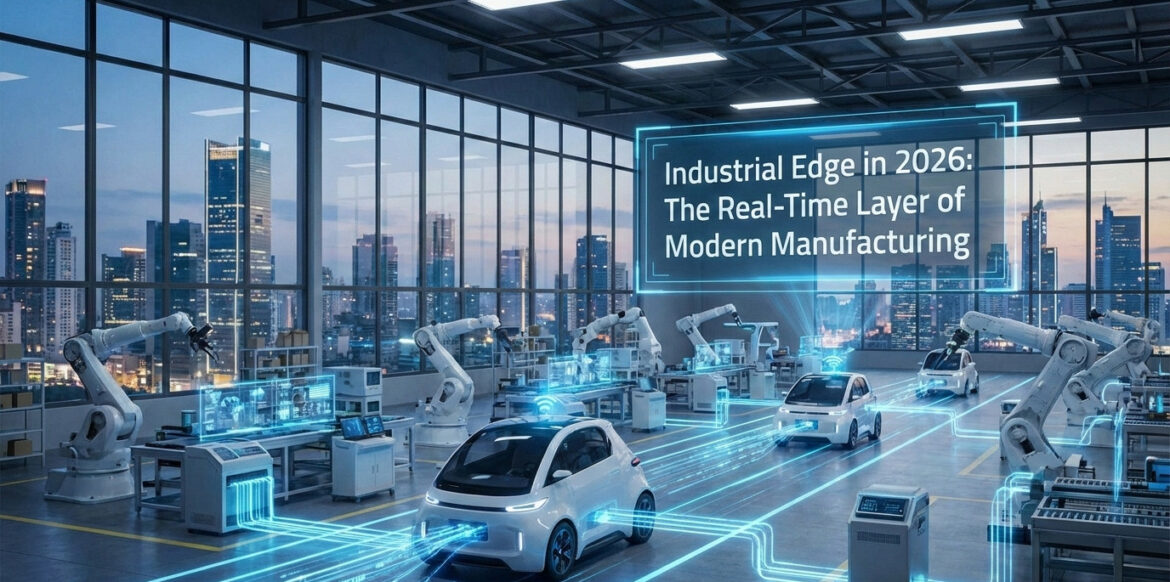
The edge layer has quietly moved from a niche concept to a core part of factory operations – the place where real‑time decisions, AI inference and machine‑level optimization actually happen. Not in the cloud, not in a remote data center, but directly on the production floor, a few milliseconds away from the equipment that needs it.
In This Article
What Industrial Edge Actually Is – Without the Marketing Layer
Industrial Edge is often described as “edge computing for industry,” but that doesn’t mean much to someone working with PLCs, SCADA or CNC machines.
In real conditions, it’s far more practical:
It’s a computer placed where data is born – next to the machines – running applications that must react in real time.
It is essentially:
- An industrial PC or gateway
- A containerized application environment
- Local data processing
- Cloud synchronization when needed
- The ability to run AI inference directly on the shop floor
It doesn’t replace PLCs, SCADA or the cloud.
This edge platform simply takes over tasks that no other layer can execute fast enough.
Why Industrial Edge Matters in 2026
The edge environment is not just another layer in the factory architecture.
In 2026, it became the place where real‑time finally meets real manufacturing.
The reason is simple: production cannot afford to wait.
Machines operate in milliseconds, and decisions must follow the same rhythm.
This is the only layer capable of doing that.
1) Real‑time performance the cloud cannot deliver
Vision inspection, robotics, safety logic – these tasks cannot tolerate latency.
Edge devices operate just meters away from the machines.
2) Local autonomy when connectivity is unstable
Factories have noise, vibration, metal structures and interference.
The edge system keeps running even when the network doesn’t.
3) Cybersecurity and data control
Raw data stays inside the factory.
Only aggregated information goes to the cloud.
4) AI inference where the process happens
Models for quality, vibration, energy and anomaly detection run directly on the edge layer.
5) Brownfield integration
The edge platform allows 20‑year‑old machines to become part of a modern architecture – without replacement.
The Technical Backbone of Industrial Edge
This technology works because it’s built on tools engineers already understand.
Containerized applications
Docker‑based containers deployed and updated without stopping production.
Sub‑10 ms processing
The heart of real‑time edge computing – tasks that cannot wait.
Secure OTA updates
Applications and AI models updated without downtime.
Local data pipelines
Sensors – Edge – PLC – SCADA – Cloud
With the ability to make decisions locally.
Interoperability
OPC UA, MQTT, Profinet, REST APIs, Modbus – the edge environment speaks the factory’s language.
What Factories Actually Use Industrial Edge For
The edge layer is already solving real problems in real factories.
Quality Inspection
Local image processing and AI models running under 10 ms.
Anomaly Detection and Machine Diagnostics
Vibration, noise, temperature – analyzed locally.
Energy Optimization
Real‑time monitoring and load balancing.
Predictive Maintenance
More accurate predictions, fewer false alarms.
Closed‑Loop Control
Edge – PLC – Machine – Edge cycles under 10 ms.
Data Harmonization
The edge platform connects old and new machines into a unified architecture.
Real‑World Deployments
As discussed in the previous article on Siemens Xcelerator, real deployments are the best way to understand how a technology performs in practice. Many of the examples highlighted there demonstrate exactly what happens when decisions are executed directly on the factory floor.
Siemens Energy
- Faster diagnostics
- Fewer unplanned shutdowns
European Automotive Manufacturer
- Local vision models
- Shorter inspection cycles
- More stable quality control
A Vuong Hydropower Plant (Vietnam)
- Optimized turbine management
- Local sensor analytics
- Optimized charging infrastructure
- Faster engineering simulations
KS Industry Solutions (Germany)
- Shorter line‑setup times
- Fewer deployment errors
Industrial Edge vs Cloud – Practical Differences for 2026
Industrial Edge is often mentioned alongside the cloud, but the two layers serve completely different roles.
In 2026, factories don’t ask “which is better,” but rather “which is right for this task.”
What the edge layer does better
- Real‑time inspection
- Motion control
- Local AI inference
- Machine diagnostics
- Sub‑10 ms reactions
What the cloud does better
- Long‑term data storage
- AI model training
- Trend analysis
- Cross‑factory integration
- Scalable computation
Where they meet
The strongest factories use both layers as a unified system:
- The edge platform processes data locally
- The cloud analyzes long‑term patterns
- The edge environment executes optimizations in real time
What Industrial Edge Means for SMEs
SMEs benefit the most from this technology because it’s practical, accessible and doesn’t require a full transformation.
1) Low entry barrier
One edge device, one app, one machine – enough for first results.
2) Small pilots with fast impact
Vision, vibration, energy – improvements in weeks.
3) No need for a large IT team
Automatic updates, centralized management.
4) Works with existing equipment
The edge layer modernizes without replacement.
5) Ready‑to‑use applications
Vision, energy, anomaly detection, predictive maintenance.
6) Real operational results
Fewer defects, fewer stoppages, better efficiency.
The Bottom Line
Industrial Edge has become one of the most important layers in modern manufacturing – not because it’s new, but because it’s practical.
It solves the problems engineers face every day: real‑time performance, stability, autonomy, security and integration with legacy machines.
In 2026, Industrial Edge is not “the next step.”
It is the current step – the real way factories become faster, smarter and more efficient without changing everything else.
And most importantly, Industrial Edge operates exactly where production happens:
next to the machines, next to the operators, next to the processes.
Right where it’s needed the most.