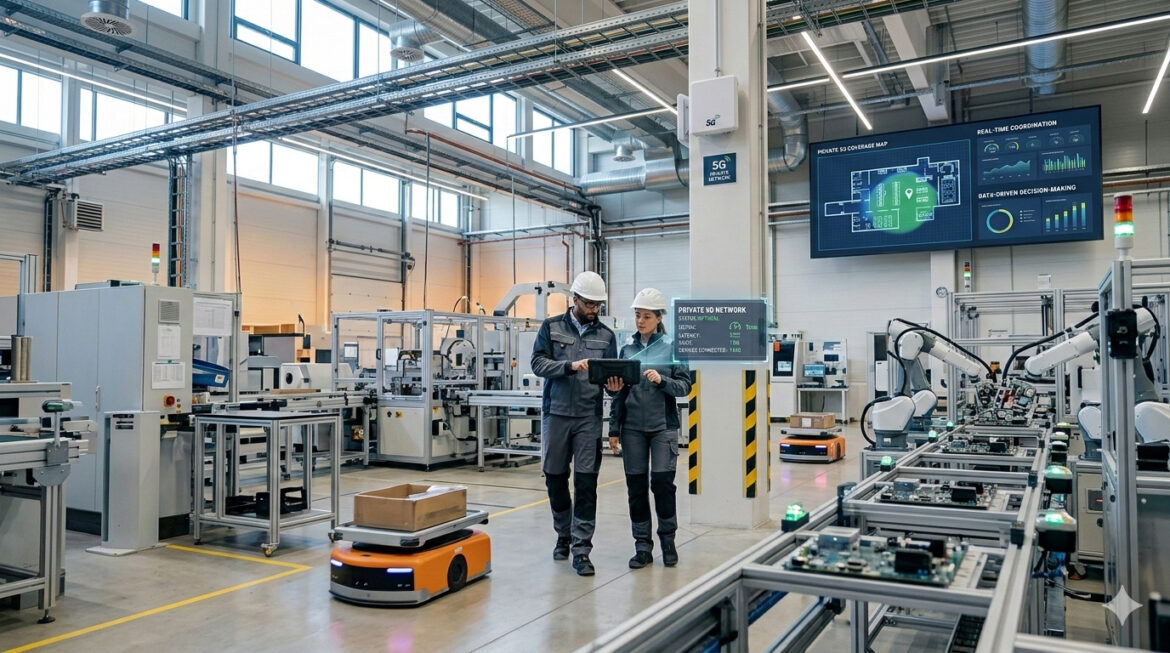
Industrial private 5G networks are becoming one of the most important building blocks of modern manufacturing. As factories move toward higher levels of automation, real‑time coordination, and data‑driven decision‑making, traditional wireless technologies are reaching their limits. The shift toward private cellular infrastructure is no longer experimental. It is a practical, proven step that many industrial companies are already taking.
In This Article
One of the most overlooked questions in modern production is surprisingly simple: How often does a manufacturing line stop because of unstable connectivity? Even a brief interruption can halt robots, freeze automated systems, disrupt machine vision, or delay quality checks. In high‑volume environments, a few minutes of downtime can translate into thousands of euros in losses. These incidents rarely make it into official reports, yet they accumulate quietly, often dismissed as “random Wi‑Fi glitches” and they are exactly the type of problems that industrial private 5G networks are designed to eliminate.
This article explores what industrial private 5G networks actually deliver, why they matter now, and how they reshape the way factories operate.
What Industrial Private 5G Networks Are
Industrial private 5G networks are dedicated mobile networks built and operated by the factory itself. Unlike public 5G, which is managed by telecom operators, a private network gives the enterprise full control over coverage, security, performance, and device access. It is designed specifically for the needs of industrial environments, where reliability and predictability are essential.
These networks run on licensed, shared, or enterprise‑allocated spectrum and support thousands of devices simultaneously. The technology has matured significantly as 3GPP standards for 5G standalone have become the global foundation for industrial deployments. Standalone 5G cores, industrial‑grade modems, and edge‑integrated architectures are now widely available, making deployment faster and more cost‑effective.
Why Factories Are Moving Toward Private 5G
Manufacturing environments are complex. They involve heavy machinery, metal structures, moving robots, and dense clusters of sensors. Wireless interference is common, and downtime is costly.
Many factories have reached the point where Wi‑Fi and wired systems can no longer support their operational demands.
Several factors are driving the adoption of industrial private 5G networks:
- The need for ultra‑low latency to synchronize robots and automated lines.
- The need for stable connectivity in environments with high interference.
- The need for secure, isolated communication channels.
- The need to support thousands of devices without congestion.
- The need for predictable performance and guaranteed quality of service.
For manufacturers, this is not just a technological upgrade. It is a strategic investment that directly affects productivity, safety, and competitiveness.
The Real Benefits for Factories
The value of industrial private 5G networks becomes clear when looking at the measurable improvements they bring to daily operations. These networks are designed to support mission‑critical processes, and their advantages are both technical and economic.
- Higher reliability. Production lines that run continuously require stable connectivity. Private 5G minimizes interruptions and ensures consistent performance.
- Low latency. Real‑time machine vision, robotic coordination, and automated quality control depend on rapid data exchange. Private 5G delivers the responsiveness these systems need.
- High device density. Factories often rely on thousands of sensors, cameras, and machines. Private 5G handles this load without degradation.
- Stronger security. The network is isolated from public infrastructure, reducing exposure to external threats.
- Better coverage. Private 5G performs well in large halls, warehouses, and metal‑rich environments where Wi‑Fi struggles.
- Simplified management. Modern solutions include centralized dashboards, automated configuration, and AI‑assisted monitoring.
- Lower long‑term costs. Fewer cables, fewer network failures, and fewer manual interventions translate into real savings.
These benefits make private 5G a foundation for the next generation of industrial automation.
Where Private 5G Makes the Biggest Difference
Some industrial applications benefit more than others from the capabilities of private 5G. According to the 5G-ACIA framework for connected industries, the technology has the strongest impact in areas requiring high-precision synchronization and mobility, such as:
- Autonomous mobile robots (AMR/AGV). Reliable mobility requires stable, low‑latency communication.
- Machine vision and real‑time inspection. High‑resolution video streams demand high bandwidth and consistent performance.
- AR/VR tools for maintenance and training. These applications rely on fast, uninterrupted data exchange.
- Connected CNC machines and PLC systems. Private 5G supports deterministic communication for precise control.
- Digital twins and simulation. Accurate models require continuous data from the physical environment.
- Asset tracking and logistics. Private 5G enables real‑time visibility across large facilities.
- Safety and monitoring systems. Reliable connectivity improves response times and situational awareness.
These use cases highlight why industrial private 5G networks are becoming essential for factories that aim to modernize.
Private 5G vs. Wi‑Fi 6/7
Many factories still rely on Wi‑Fi, so the comparison is unavoidable. Wi‑Fi 6 and Wi‑Fi 7 offer improvements, but they remain best suited for office environments rather than industrial ones.
Wi‑Fi is less predictable under heavy load, more vulnerable to interference (especially in metal‑dense areas), and is essentially a shared medium. While easier to deploy initially, it often leads to higher long-term operational costs due to the “glitches” we discussed.
In industrial settings, predictability and reliability matter more than initial price. This is why many manufacturers are transitioning to private cellular networks:
| Feature | Wi‑Fi 6 / 7 | Industrial Private 5G |
| Predictability | Best‑effort delivery; performance can drop under load. | Deterministic performance; guaranteed Quality of Service (QoS). |
| Interference | High sensitivity to metal structures and overlapping signals. | Designed for high‑interference environments; utilizes protected spectrum. |
| Mobility (Handover) | Risk of “micro‑breaks” when moving between access points. | Seamless, lossless handover-essential for high‑speed AMRs and AGVs. |
| Security | Software‑based encryption; larger attack surface on public bands. | Hardware‑based security (SIM/eSIM); complete isolation from public traffic. |
| Device Density | Connection quality degrades as sensor count increases. | Massive scalability; supports up to 1M devices per sq. km. |
| Coverage | Struggles with deep indoor penetration and large halls. | Superior range per cell; excellent penetration through heavy machinery. |
The security of these networks is not just software-based; it follows rigorous cybersecurity frameworks for industrial control systems, utilizing hardware-based authentication through SIM/eSIM technology to ensure complete isolation from public traffic.
What’s New
A new wave of developments is turning industrial private 5G networks into a more accessible and more powerful option for manufacturers. Several advancements across hardware, spectrum availability, and network management are accelerating adoption and making the technology easier to deploy at scale:
- Standalone 5G cores are now standard, enabling full 5G performance without relying on older infrastructure.
- Edge‑native architectures allow data processing to happen close to the machines, reducing latency.
- AI‑assisted network management simplifies operations and improves uptime.
- Industrial modems and routers have become more affordable and more energy‑efficient.
- New spectrum options give factories more flexibility in deployment.
- Solutions tailored for small and medium‑sized manufacturers are emerging, lowering the entry barrier.
These advancements make private 5G a realistic option even for factories that previously considered it too complex or expensive.
How Factories Can Begin Their Private 5G Journey
Deploying industrial private 5G networks does not have to be a large‑scale project from day one.
Many companies start small and expand gradually.
A typical roadmap includes:
- Assessing operational needs and identifying critical processes.
- Choosing the appropriate spectrum and network architecture.
- Selecting technology partners and integrators.
- Setting up a pilot zone to validate performance.
- Integrating the network with existing machines, sensors, and edge systems.
- Training staff to manage and maintain the infrastructure.
- Scaling the deployment across the entire facility.
This phased approach reduces risk and ensures that the network delivers value from the start.
What’s Next
Industrial private 5G networks are becoming a core component of modern manufacturing. The technology is no longer experimental or limited to early adopters; it has evolved into a practical, reliable solution that improves efficiency and reduces downtime.
As highlighted in recent market analysis on private cellular adoption, the shift toward dedicated infrastructure is becoming a key differentiator for global competitiveness. Combined with edge computing and AI, private 5G forms the backbone of the next generation of factories – more connected, more flexible, and more competitive.