In This Article
Sustainability Begins with the Software Foundation
In modern manufacturing, sustainability is often associated with energy‑efficient machines, optimized production lines, and reduced waste. Yet behind every efficient factory and every streamlined supply chain lies something far less visible but equally essential: the software infrastructure that keeps industrial systems running. Increasingly, that foundation is built on Oracle Linux – a platform valued for its stability, predictability, and ability to support mission‑critical operations without interruption.
Industrial environments rarely reward experimentation. They reward reliability. They reward systems that can run for years without surprises, without sudden incompatibilities, and without forcing downtime that disrupts production. This is precisely why Oracle Linux has become a preferred choice for companies operating complex manufacturing systems, ERP platforms, and large‑scale industrial infrastructure. In sectors where operational continuity is directly tied to sustainability goals, the operating system becomes a strategic asset rather than a background component.
The shift toward smarter, more connected factories – a trend explored in analyses such as how smart factories are reshaping modern manufacturing – has only increased the need for a stable and secure operating system. As industrial automation grows more data‑driven and interconnected, the underlying platform must be capable of supporting real‑time decision‑making, predictive analytics, and continuous data flows without compromising performance or energy efficiency.
Oracle Linux as the Backbone of Industrial Automation
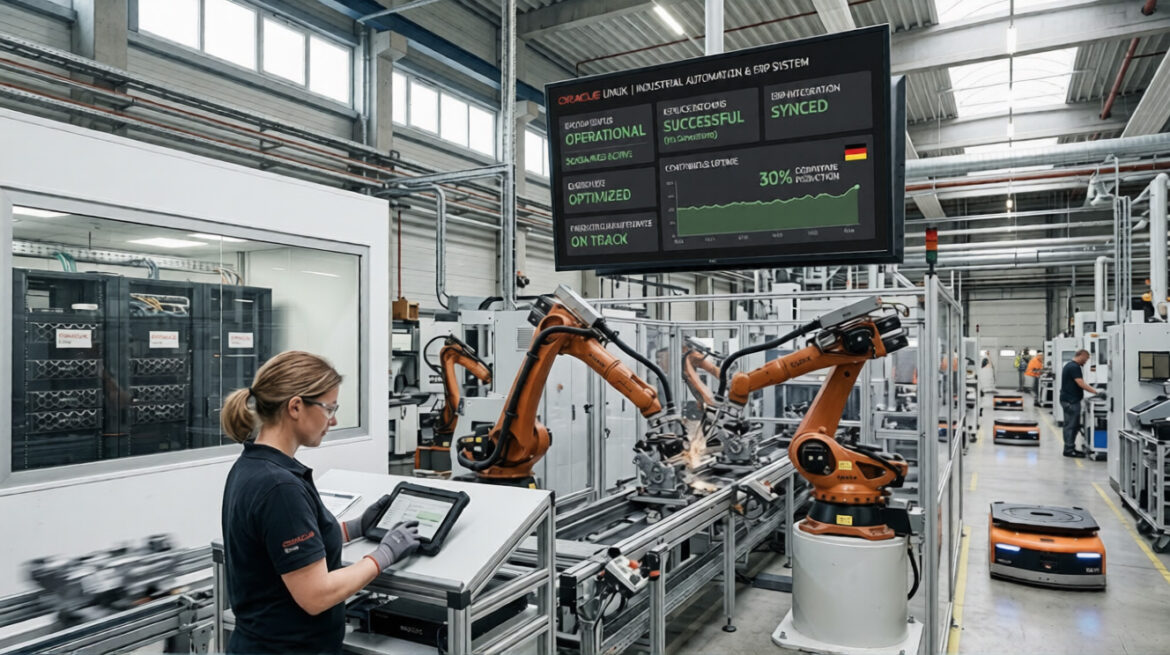
In industrial automation, Oracle Linux serves as the operating foundation for SCADA, MES, and IIoT platforms – systems that must operate continuously and reliably. A halted production line can mean lost revenue, missed delivery windows, and wasted materials. Oracle Linux addresses these challenges with long‑term support, predictable updates, and an optimized kernel designed to withstand the demanding workloads typical of industrial operations.
One of the most valuable features in this context is Ksplice, Oracle’s technology for applying kernel updates without requiring a reboot.
“In real factories, Ksplice means production lines keep running, and operators do not need to shut down equipment just to apply security patches.”
A major manufacturing group in Germany reported a 30% reduction in planned downtime after migrating its automation servers to Oracle Linux with Ksplice. Eliminating reboot‑related maintenance windows allowed the company to keep MES and SCADA systems online during peak production cycles – a change that translated directly into higher throughput and lower energy waste.
This aligns with broader industry trends toward uninterrupted, resilient operations – a topic also reflected in discussions about industrial IoT security and smart factory resilience. As factories become more connected, the ability to update systems without downtime becomes a critical part of maintaining both operational efficiency and environmental responsibility.
Sustainability Gains Enabled by Oracle Linux
Lower Energy Consumption – fewer reboots mean fewer high‑load restart cycles. Reduced Waste – continuous monitoring prevents process interruptions. Extended Hardware Life – optimized resource usage reduces thermal and mechanical stress.
Infrastructure Automation as a Driver of Sustainability
Automation is not limited to production lines. The infrastructure that supports industrial systems must also be automated to ensure consistency, efficiency, and long‑term sustainability. Oracle Linux Automation Manager, built on Ansible, enables companies to manage hundreds or thousands of servers and devices in a standardized way. This includes automated configuration, deployment, patching, and lifecycle management across multiple facilities.
In practice, this means a company can deploy a new MES platform across several plants simultaneously, without relying on manual processes that are slow, error‑prone, and resource‑intensive. Automated infrastructure reduces the need for on‑site interventions, minimizes human error, and ensures that systems remain in an optimal state throughout their lifecycle.
This has a measurable sustainability impact. Fewer site visits mean fewer emissions. Fewer configuration errors mean fewer production disruptions. Better‑maintained systems last longer, consume fewer resources, and operate more efficiently.
These principles echo the broader movement toward greener industrial operations, explored in analyses such as green manufacturing and sustainable industrial technologies.
Oracle Linux in Modern ERP Ecosystems
While industrial automation depends on real‑time control systems, the broader enterprise relies on ERP platforms to manage planning, finance, supply chains, and human resources. In this environment, Oracle Linux plays a different but equally critical role. It is the recommended operating system for Oracle Database, Oracle Cloud ERP, and Oracle E‑Business Suite – systems that form the digital backbone of many manufacturing organizations.
When ERP workloads run on an operating system optimized specifically for them, the benefits are immediate: faster processing, lower latency, and more predictable performance under heavy load. For large manufacturers, this translates into more accurate forecasting, smoother production planning, and better resource allocation.
A practical example illustrates this well. Imagine a manufacturer using Oracle Linux to run its ERP system, which is tightly integrated with the MES platform on the factory floor. When the ERP module generates a new production schedule, the MES receives it instantly and adjusts the lines accordingly. If the ERP system were slow or unstable, the result could be misaligned production runs, unnecessary material usage, or inefficient labor allocation. By ensuring stability and performance at the OS level, Oracle Linux helps prevent these issues before they occur.
This connection between data, planning, and execution is a recurring theme in modern manufacturing, explored in analyses such as the role of data in manufacturing. As factories become more data‑driven, the reliability of the systems that process and distribute that data becomes a key factor in both operational efficiency and sustainability.
Containerization and Modern Industrial Architectures
Another area where Oracle Linux has become increasingly important is containerization. With built‑in support for Podman and Kubernetes, the platform enables companies to deploy ERP components, integration services, and analytics tools in a more flexible and resource‑efficient architecture.
Containers start quickly, use fewer resources, and allow workloads to be distributed intelligently across hybrid environments. This is particularly valuable for manufacturers operating across multiple sites or combining on‑premises systems with cloud‑based services.
Instead of relying on large, monolithic applications, companies can break their systems into smaller, containerized components that scale independently and consume only the resources they need. This reduces hardware requirements, extends the life of existing infrastructure, and lowers the overall energy footprint.
The shift toward containerized and cloud‑ready architectures mirrors broader trends in industrial digitalization, including the rise of industrial edge computing and the adoption of private 5G networks for real‑time connectivity. Oracle Linux fits naturally into this ecosystem, providing a stable and secure foundation for workloads that must operate reliably at the edge, in the cloud, or across distributed environments.
Real‑World Industrial Scenarios and Their Sustainability Impact
In logistics centers, Oracle Linux often powers systems responsible for warehouse automation, order processing, and transportation management. These environments depend on precise coordination. A delay in one system can lead to misrouted shipments, inefficient storage, or unnecessary vehicle trips. When the underlying infrastructure runs smoothly, logistics operations become more predictable, routes are optimized more effectively, and empty runs are reduced – all of which contribute to lower emissions and better resource utilization.
This aligns with the broader transformation of logistics and automation, explored in analyses such as the rise of robotics in logistics and the adoption of autonomous mobile robots.
In industrial IoT environments, Oracle Linux is frequently used as the operating system for edge devices that collect data from machines, sensors, and production lines. These devices process information locally, reducing the need to send large volumes of data to central servers. This saves energy, reduces network load, and enables faster responses to anomalies such as temperature fluctuations, vibration spikes, or unexpected energy consumption.
Predictive maintenance – a topic explored in depth in AI‑driven predictive maintenance – becomes more accurate, equipment lasts longer, and unplanned downtime is minimized. All of this contributes to a more sustainable industrial ecosystem.
A Foundation for Long‑Term Industrial Sustainability
All these examples point to a broader truth: Oracle Linux is not just an operating system. It is a strategic enabler for companies seeking greater sustainability, lower operational costs, and more predictable performance across their industrial and enterprise environments.
In the era of Industry 4.0 – a transformation explored in depth in analyses such as the future of industrial automation – sustainability is no longer a side initiative. It is a core requirement for competitiveness.
Modern factories are expected to operate with minimal waste, optimized energy consumption, and maximum uptime. Achieving this requires a combination of technologies, processes, and architectural decisions that reinforce each other. Oracle Linux fits naturally into this ecosystem because it provides a stable, secure, and efficient foundation for systems that manage everything from production lines to corporate finance.
The ability to automate infrastructure, reduce downtime, optimize hardware usage, and support modern architectures such as containers and edge computing makes Oracle Linux a practical tool for reducing environmental impact. These improvements are not theoretical – they translate into measurable gains in energy efficiency, equipment longevity, and resource utilization.
They also align with the broader movement toward sustainable industrial practices, reflected in reports such as emerging sustainability trends and technologies.
Why Oracle Linux Matters in the Bigger Picture
The industrial sector is undergoing a profound shift. Manufacturers are integrating robotics, AI, IIoT, and advanced analytics into their operations. They are adopting private 5G networks, deploying digital twins, and moving toward autonomous production environments – innovations explored in digital twins in heavy industry.
These systems depend on a reliable, secure, and high‑performance operating system. Oracle Linux provides exactly that. Its long‑term support, predictable update cycles, and enterprise‑grade security make it a natural fit for mission‑critical environments. Its compatibility with Oracle’s broader ecosystem ensures that ERP, database, and middleware layers operate at peak efficiency.
And its support for modern deployment models – from containers to hybrid cloud – ensures that companies can evolve their infrastructure without sacrificing stability.
The Bottom Line: Oracle Linux as a Driver of Sustainable Industrial Transformation
Sustainability in manufacturing is not achieved through a single technology or initiative. It is the result of countless decisions – from how machines are maintained to how data is processed, how systems are updated, and how infrastructure is managed.
Oracle Linux plays a quiet but essential role in this landscape. It enables continuous operations, supports automation at every level, and provides the stability required for advanced industrial systems to function reliably.
In a competitive global market, where efficiency and environmental responsibility go hand in hand, Oracle Linux stands out as a practical, proven, and forward‑looking choice – a platform built not just for today’s industrial challenges, but for the sustainable factories of the future.