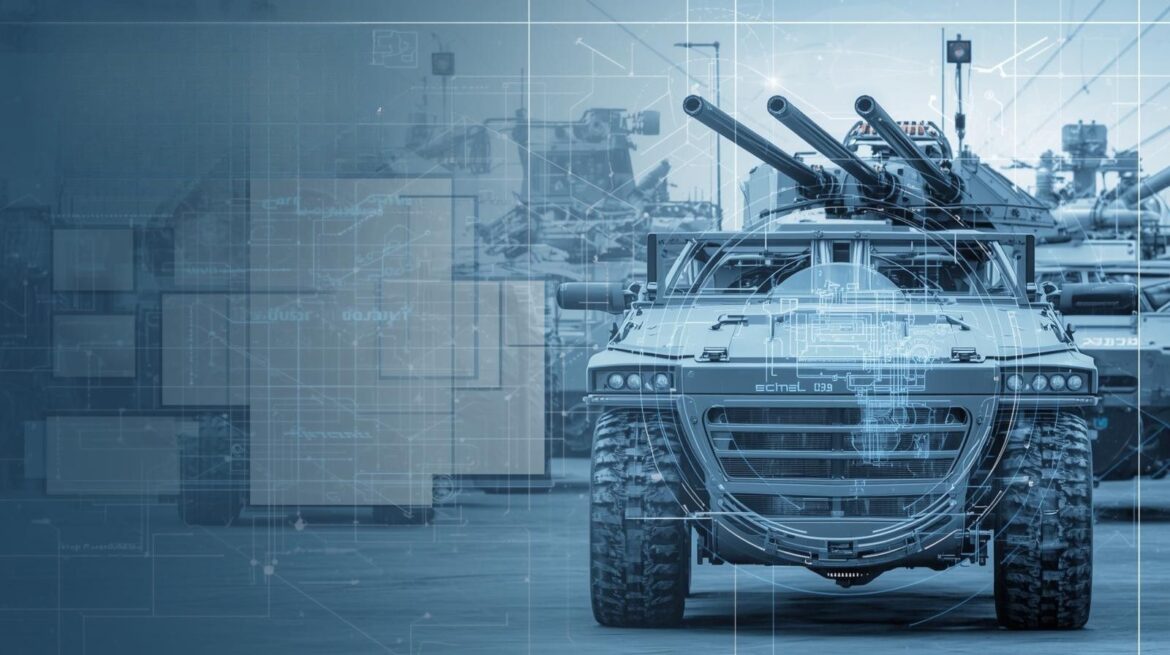
Rheinmetall AG has become one of Europe’s fastest-moving industrial groups in 2024–25 — not only because of sharply increased defence demand, but because the company is intentionally industrialising automation, digitalisation and platform-style offerings to capture scale advantages. This article summarises the technologies Rheinmetall has already deployed, its stated targets for 2025, the most important news through mid-2025, and an evidence-based outlook for how the company may evolve across 2026.
Snapshot: company context and 2025 targets
Rheinmetall closed 2024 slightly under €10 billion in sales and guided for a step-up in 2025, expecting a 25–30% increase in sales and an operating margin around 15.5%, driven principally by defence orders and a large backlog. Management has publicly signalled ambitious medium-term goals (sales guidance toward €40–50 billion by 2030), and plans to expand headcount significantly to support production scale-up.
What automation and Industry-4.0 tech Rheinmetall is using today
1. Robotics, teleoperation and autonomy
Rheinmetall is showcasing advanced robotics and teleoperated systems across major trade fairs (Hannover Messe, Automatica, DSEI), demonstrating both in-house solutions and partner products (for example via YardStick Robotics). The company’s product lines increasingly blend robotic manipulators, autonomous platform kits (Path-A-Kit) and teleoperation for remote or hazardous tasks. These systems serve dual use cases — military autonomy and factory automation for scalable assembly lines.
2. Edge-to-cloud data & digital twins
Rheinmetall describes itself as a systems integrator that covers the chain “from sensor to shooter,” and the digitisation pages highlight edge analytics, secure data pipes and digital-twin workflows for vehicles and weapon systems. That same stack is repurposed internally to accelerate production ramp-up: digital twins for vehicle assembly lines, virtual commissioning and predictive maintenance reduce commissioning time and improve first-time quality.
3. AI, secure comms and MRO analytics
The company has increased stakes in firms and technologies that strengthen AI-enabled diagnostics, secure networking and mission systems (for example the majority share in blackned GmbH to beef up digital services for armed forces). AI is also applied in quality inspection, parts traceability and weapon-system diagnostics.
4. Automated munitions and ammunition production lines
Rheinmetall’s recent investments and capacity expansions in munitions are explicitly automated: high-throughput production cells, robotics for handling energetic materials, and digital process controls are core to lowering unit costs as volumes scale. Management argues that automation will bring unit price benefits even while volumes surge.
Concrete 2025 targets and operational priorities
Rheinmetall’s public guidance and filings identify several short-term priorities for 2025:
- Revenue & margin: Increase group sales 25–30% year-on-year in 2025 with an operating margin ~15.5%.
- Backlog & capacity: Convert a rapidly growing defence backlog into delivered revenues by scaling production lines and adding ammunition capacity across Europe. Management has signalled a multi-€bn uplift in orders and backlog.
- Industrialisation via automation: Roll out robotics, teleoperation and digital line control to compress lead times and improve repeatability at scale (e.g., automating welding, machining, and final assembly tasks).
- M&A & partnerships: Acquire capabilities in digital services (blackned majority stake) and partner internationally (example: cooperation with Anduril for drones) to access high-speed innovation.
Latest news (high-impact items through mid-2025)
Q1 / H1 2025 results: Rheinmetall reported record growth in early-2025: steep increases in sales and income driven by defence demand, with civilian businesses lagging in some segments. The half-year statements reported rising backlog and strong margins.
Anduril partnership (June 2025): Rheinmetall announced a strategic partnership with U.S. drone-maker Anduril to produce European variants of tactical drones and explore missile/rocket motor production — a major step to combine rapid-cycle U.S. tech with Rheinmetall manufacturing.
Blackned majority stake (Jan 2025): Rheinmetall increased its holding in blackned GmbH to 51% to strengthen its digitalisation and secure-communications offering for defence customers.
Trade-fair showcases: Demonstrations at Hannover Messe and Automatica 2025 highlighted teleoperated driving, robotics, and AI/data ecosystems — underlining the push to commercialise robotic and autonomy technologies for both defence and industrial customers.
Analysis – how automation and these moves change Rheinmetall’s business through 2026
Upside drivers
- Scale economics from automation. As orders convert into production, automated lines and digital workflows should lower per-unit labour costs and cut cycle time — crucial when ramping ammunition and vehicle output. Management expects costs to fall with scale, improving competitiveness and supporting margin targets.
- Faster time-to-market via partnerships. Collaborations with fast-moving tech firms (Anduril) accelerate product development cycles without building everything in-house. This lowers R&D calendar risk and lets Rheinmetall focus on manufacturing and systems integration.
- Services and digital revenue. Investments in digital firms and secure communications enable recurring revenues (upgrades, data services, MRO contracts) which are higher margin than pure hardware.
Risks and constraints
- Order concentration and political risk. Defence demand is geopolitical; while strong now, policy shifts or procurement delays in major customers could create revenue timing risk.
- Supply-chain & skilled labour bottlenecks. Rapid scale-up requires qualified engineers and technicians; automation helps, but integration projects still need skilled OT/IT staff.
- Integration complexity. M&A and partnerships carry integration and cultural risk; Rheinmetall must rapidly standardise data, security and processes across acquired firms.
2026 outlook (evidence-based projection)
If Rheinmetall executes its 2025 automation and capacity plans, then 2026 should show:
- Higher output and improving unit economics in ammunition and vehicle lines thanks to automated cells and improved digital planning.
- An expanding services backlog (MRO, software, data services) that smooths revenue volatility.
- Broader product portfolio (drones, autonomy kits, digital comms) sold into both European and allied markets through partnerships and local production footprints.
Quantitatively, analysts’ guidance and company targets imply continued double-digit top-line growth into 2026 (absent major policy reversals), with margin resilience provided automation reduces manufacturing bottlenecks.
Bottom line – what to watch next
- Order conversion cadence: Monitor monthly/quarterly backlog conversion into delivered revenues. Faster conversion = validation of automation plans.
- Execution of partnerships: Anduril collaboration and blackned integration milestones will show whether Rheinmetall can absorb fast-paced tech partners.
- Operational KPIs: Yield improvements, cycle-time reductions, and headcount per unit produced — these will evidence automation ROI.
- Regulatory / procurement changes: Any major shifts in defence procurement (EU/Germany) will materially affect demand timing.
Sources (selected / load-bearing):
Rheinmetall Q1 and H1 2025 financial statements and press releases.
Reuters: Rheinmetall 2025 sales guidance and commentary.
Partnership announcement: Anduril – Reuters (June 2025).
Company press: Automatica & Hannover Messe 2025 robotics and teleoperation showcases.
Acquisition: Rheinmetall increases stake in blackned GmbH (Jan 2025).
CEO interviews / FT coverage on scale and automation economics.