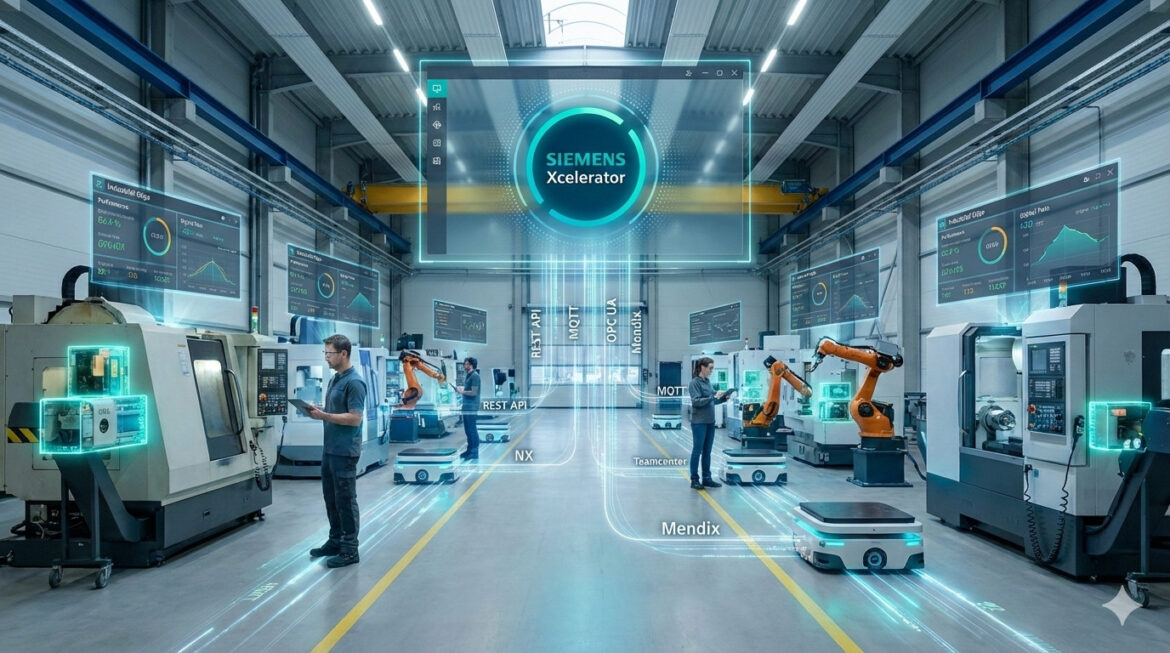
Walk into any modern factory today and you’ll notice something immediately: the conversations on the floor are no longer just about cycle times, tolerances or throughput. They’re about data flows, APIs, dashboards, edge devices and software updates.
This shift didn’t happen overnight – but in 2026, Siemens Xcelerator is accelerating it faster than any other platform on the market.
Not as a buzzword.
Not as another corporate “digital transformation” slogan.
But as a practical, modular ecosystem that manufacturers are actually deploying to connect machines, software and people in a way that finally feels coherent.
As part of our Industrial Innovation Series, after exploring how Arduino App Lab democratizes low‑code development, we now move to the next layer of industrial digitalization – the enterprise‑grade framework that ties entire factories together, known as Siemens Xcelerator.
In This Article
What This Ecosystem Really Is – Without the Marketing Gloss
The platform is often described as an “open digital business platform,” but that phrase doesn’t tell you much.
Here’s the real picture – the one engineers and plant managers care about.
At its core, Xcelerator is the backbone of the modern smart factory ecosystem, breaking down the walls between traditional hardware and the new era of software-driven production.
It’s three things at once:
1) A modular software ecosystem
Including:
- Industrial Edge
- MindSphere
- Teamcenter
- NX
- Mendix
- Opcenter
- Digital Twin solutions
2) A marketplace
With more than 1,000 certified partners offering:
- Industrial apps
- Connectors
- Analytics tools
- Hardware modules
- Cloud integrations
3) An interoperability framework
Built around:
- OPC UA
- MQTT
- Profinet
- REST APIs
- Standardized data models
Quick Overview
| Component | Core Function | Business Value |
|---|---|---|
| Industrial Edge | On‑premise data processing | Low latency, security, real‑time insights |
| Mendix | Low‑code development | Fast app creation without large IT teams |
| Teamcenter | Product Lifecycle Management | Single source of truth for product data |
| MindSphere | Cloud IoT analytics | Predictive maintenance at global scale |
Why Siemens Xcelerator Matters in 2026
Manufacturers today face a brutal reality:
- Labor shortages
- Rising energy costs
- Pressure for sustainability
- Demand for shorter production cycles
- Aging equipment
- Fragmented software stacks
Siemens Xcelerator addresses these challenges by offering something the industry has been missing for years:
a unified, open, vendor‑agnostic platform that doesn’t force factories into a single ecosystem.
The Technical Backbone: What Makes This Framework Stand Out
1) Digital Twins With Real Performance Numbers
Digital twins are not new, but the system pushes them into real‑time territory:
- Simulation updates with latency under 20 ms
- Real‑time PLC synchronization
- Closed‑loop optimization
- Predictive maintenance based on live sensor data
2) Industrial Edge: Computing Where It Matters
Industrial Edge enables:
- Deterministic processing
- Sub‑10 ms response times
- Containerized workloads
- Secure OTA updates
- Local AI inference
Factories rely on it for:
- Anomaly detection
- Quality inspection
- Energy optimization
- Machine diagnostics
3) Open APIs, Interoperability – and Brownfield Integration
This is where Siemens Xcelerator breaks the old industrial paradigm.
Instead of locking customers into proprietary protocols, Xcelerator embraces:
- OPC UA
- MQTT
- REST APIs
- Profinet
And perhaps its most underrated strength is brownfield integration. Factories don’t need to replace their 20‑year‑old CNC machines or legacy PLCs – Xcelerator can connect to them through adapters, protocol converters and Industrial Edge gateways, giving old equipment a second life in a fully digital environment.
4) Cybersecurity Built Into the Architecture
- Zero Trust architecture
- Encrypted communication (TLS 1.3)
- Role‑based access control
- Secure container execution
- ISO/IEC 27001‑certified cloud infrastructure
These protections do more than just secure data; they ensure that the production line never halts due to a cyberattack-an event that can cost millions per hour. Security remains a top priority, as discussed in our guide on IIoT security for 2026.
The Role of AI in the Ecosystem (2026)
In 2026, the platform increasingly relies on generative AI to accelerate engineering workflows:
- AI‑assisted CAD exploration in NX
- Automatic PLC logic generation through Mendix
- Predictive models retraining themselves on Industrial Edge
- Generative design for components and production layouts
AI is no longer an add‑on – it’s embedded in the engineering workflow.
Real‑World Deployments
1) Industrial Manufacturing
Siemens Energy
- 31% increase in OEE
- 25-36% reduction in machining time
- 26% lower CAx engineering costs
European Automotive Manufacturer
- ROI in under 3 months
- Up to 50% fewer unplanned stops
- Tens of millions of euros saved
Köber – a Romanian manufacturer of industrial paints and coatings
- 70% fewer non‑conformance reports
2) Energy and Infrastructure
A Vuong Hydropower Plant (Vietnam) – a major hydroelectric facility supplying renewable energy in central Vietnam
- Optimized operating costs
- Improved energy management
Nemo’s Garden – an Italian underwater agriculture project developing biosphere-based ocean farming
- Faster innovation cycles
- Optimized biosphere design
3) Transportation and High‑Tech
Volta Trucks – a European manufacturer of fully electric urban delivery trucks
- Optimized charging networks
- Accelerated decarbonization
Axiom Space – the company building the world’s first commercial space station
- Unified digital workflow
- Accelerated design cycles
4) Digital Planning and Simulation
KS Industry Solutions – a German automation provider specializing in digital twins and production simulation
- 15% higher throughput
- 10-20% efficiency improvement
Sulzer – a Swiss industrial engineering company known for pumps, chemical processing and surface technologies
- Faster onboarding
- Fewer deployment errors
5) Retail and Energy Efficiency – Lidl
IoT Lighting (Enlighted)
- 50% lower lighting costs
Low‑Code Digitalization (Mendix)
- Supports 575,000+ employees
Energy Management
- Cloud‑based monitoring
- Reduced consumption
Bridging the OT-IT Divide
The framework aligns:
- OT stability
- IT security
- Management speed
- Engineering flexibility
What It Means for SMEs
- Lower entry costs
- Modular adoption
- Marketplace apps
- Reduced vendor lock‑in
Why It Matters
This open ecosystem is rapidly becoming the digital backbone of modern manufacturing – modular, interoperable, fast and intelligent in real time.