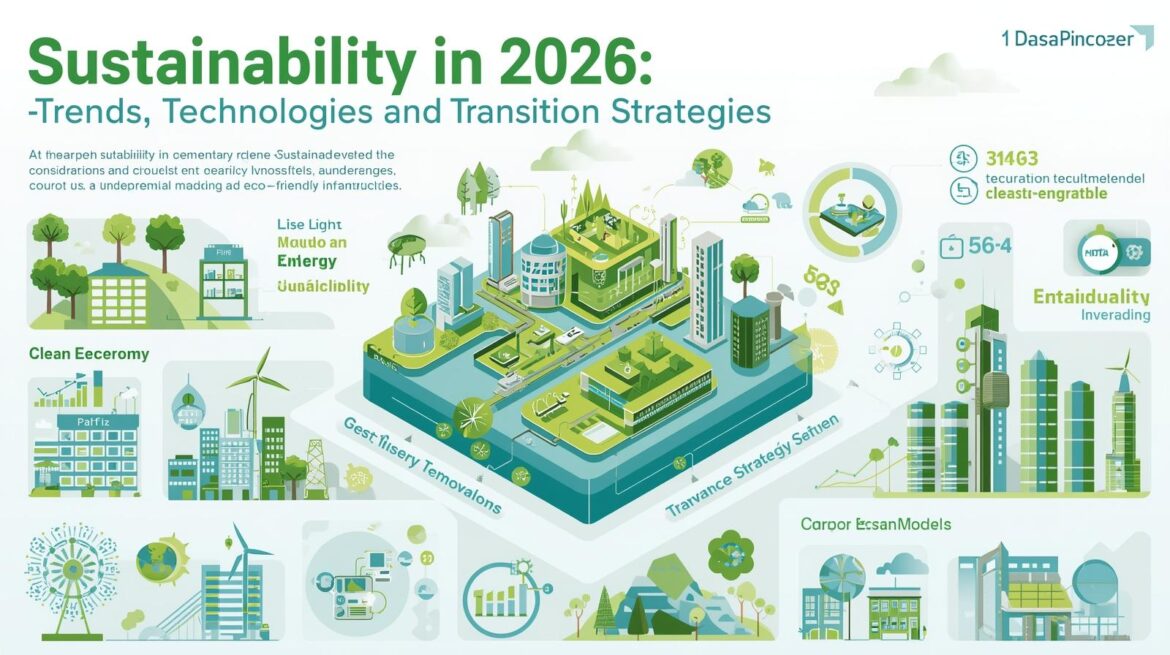
Sustainability has shifted from being a nice‐to‐have to an essential strategic pillar. Companies, governments and society at large are no longer asking if sustainability matters but how quickly and how deeply they can integrate it. With the dramatic pace of change in regulations, technologies and stakeholder expectations, 2026 promises to be a pivotal year for sustainable transformation.
In This Article
1. Regulation & Reporting: The New Era of Transparency
The rules are tightening. A fresh wave of reporting standards and regulatory frameworks is reshaping how organizations disclose their environmental, social and governance (ESG) performance. Companies must now consider not only what they emit or consume, but how they measure, govern and disclose it.
2. Circular Economy & Regenerative Design
Gone are the days when “reduce, reuse, recycle” was enough — the next frontier emphasises circular economy models (designing for longevity, reuse and regeneration) and regenerative design (restoring ecosystems and social systems rather than simply reducing harm). Examples: buildings that generate more energy than they consume; agriculture that rebuilds soil health; manufacturing loops that bring used materials back into the system.
3. Sustainability in Tech & Digital Infrastructure
Technology itself is under pressure to become sustainable. Data centres, AI training infrastructure, and digital device lifecycles are significant energy and material consumers. One analysis projects enterprise IT alone may grow to account for up to 14 % of global greenhouse emissions by 2040 unless changes accelerate. Organizations are now rethinking procurement, device use-cycles, cloud infrastructure and energy sourcing as central elements of sustainability strategy.
4. Sustainable Supply Chains & Traceability
Supply chain scrutiny has reached a new level. For example, in the cocoa sector of Côte d’Ivoire, exporters must prove their products are deforestation-free under EU law — a transformation driven by regulation, market access and ethical pressure. Traceability, material origin, human rights, and ecological impact are now intertwined with how companies source and move goods.
5. Renewable Energy, Storage & Investment Growth
Investment in renewables continues to accelerate, but storage and system integration are becoming the game-changers. Models show that combining solar photovoltaics (PV) with large-scale storage now produces competitive outcomes faster than traditional carbon taxes. For firms and governments, the priority is shifting from can we adopt renewables? to how do we integrate, scale and optimise them for flexibility, demand-response and circularity?
6. Social Equity, Biodiversity & the Bigger Picture
True sustainability is more than carbon numbers. It’s increasingly about social equity, biodiversity restoration, community resilience and intergenerational fairness. The list of trends for 2026 emphasises biodiversity impact, water stewardship, and sustainable supply chain practices. Companies that ignore the social or ecological dimensions risk reputational loss, regulation or stranded assets.
7. From Ambition to Action: What Organizations Should Do
- Embed sustainability into core strategy rather than treat it as a separate programme.
- Upgrade data, governance and disclosure: strong metrics and traceability are now baseline requirements.
- Focus on system change: e.g., end-to-end circular supply chains, tech infrastructure efficiency, regenerative design.
- Show scalability: pilot projects are nice, but investors and stakeholders expect evidence of broader rollout.
- Engage stakeholders across value chains — including communities, suppliers, regulators and customers — to co-design sustainable pathways.
8. Why 2026 Matters
In 2026, the sustainability agenda hits full stride. The convergence of regulation, tech disruption, investor pressure and consumer expectation means there is no “waiting” lane. Whether you’re a tech firm, a manufacturer, a service provider or a startup, sustainability increasingly spells competitive advantage — or risk if ignored.
9. Frequently Asked Questions about Sustainability in 2026
What are the major sustainability regulatory changes expected in 2026?
By 2026, the Corporate Sustainability Reporting Directive (CSRD) and other global frameworks will move from phase-in to full enforcement. Companies will be required to provide “double materiality” assessments, reporting not only on how climate change affects their business but also how their operations impact the environment and society.
How does AI impact corporate sustainability strategies?
In 2026, AI is a double-edged sword. While it optimizes energy grids and supply chains, the massive energy consumption of data centers remains a challenge. Sustainable organizations are now prioritizing “Green AI”—algorithms optimized for energy efficiency—and sourcing 24/7 carbon-free energy for their digital infrastructure.
What is the difference between Circular Economy and Regenerative Design?
While the Circular Economy focuses on eliminating waste and keeping materials in use (doing “less harm”), Regenerative Design goes a step further. It aims to actively restore and transition ecosystems, such as agriculture that traps more carbon than it releases or urban developments that improve local water quality.
Why is supply chain traceability critical in 2026?
Due to strict regulations like the EU Deforestation Regulation, companies can no longer claim ignorance about their lower-tier suppliers. Traceability through blockchain and satellite monitoring has become a market-access requirement, ensuring products are ethically sourced and environmentally neutral.