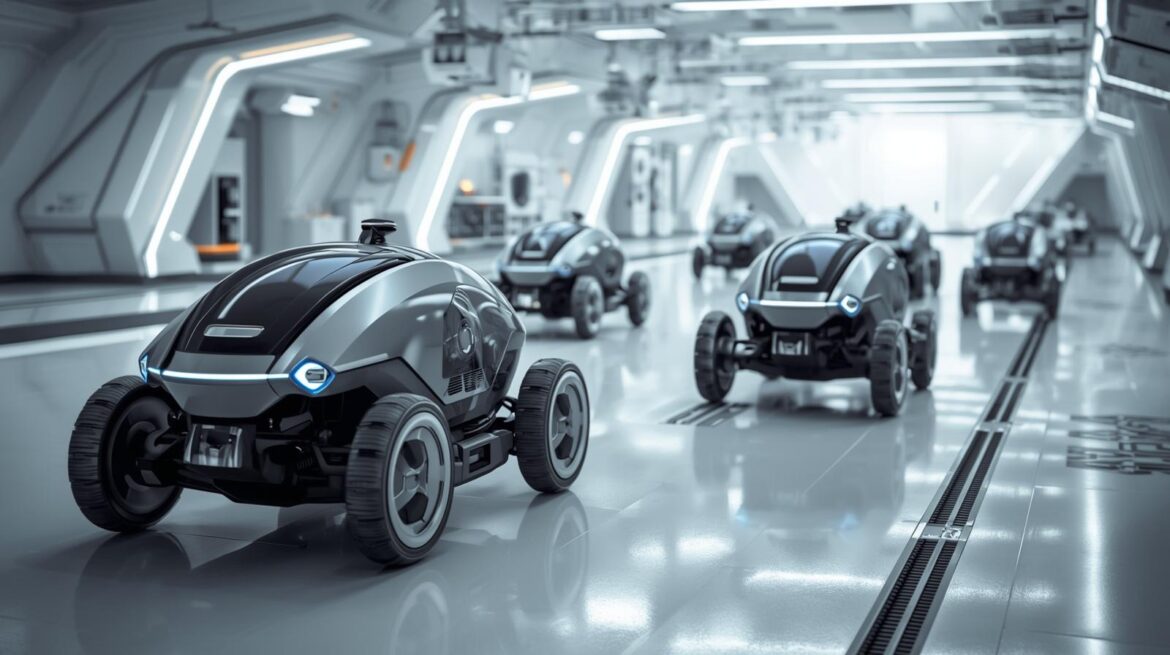
Over the past decade, factories and warehouses have undergone a silent but powerful transformation. Autonomous Mobile Robots (AMRs) — once viewed as experimental or niche — are now becoming a visible and influential force across manufacturing, logistics, and distribution centers.
But an important question remains:
Are AMRs simply another automation trend, or are they becoming an essential tool for the future of industry?
To answer this, we need to move beyond hype. This article explores what AMRs really deliver today, where they fall short, and why their role is likely to grow significantly by 2030.
What Are AMRs — and Why Are They Different?
Autonomous Mobile Robots are self-navigating robots designed to transport materials, components, or products without fixed paths or external guidance systems. Unlike traditional Automated Guided Vehicles (AGVs), AMRs:
- Navigate dynamically using sensors, cameras, and LiDAR
- Adapt routes in real time
- Avoid obstacles autonomously
- Require minimal infrastructure changes
This flexibility makes them particularly attractive in environments where layouts change frequently — such as e-commerce warehouses, mixed-model manufacturing lines, and smart factories.
Their rapid adoption reflects a broader industrial shift: from rigid automation toward adaptive, software-driven systems.
Why AMRs Are Gaining Momentum
Several structural pressures are accelerating AMR adoption.
Labor Shortages
Manufacturing and logistics face persistent workforce gaps. According to Deloitte, millions of industrial roles may go unfilled globally by 2030. AMRs help fill operational gaps without replacing skilled human workers entirely.
Demand for Flexibility
Modern production is no longer linear. Shorter product life cycles and mass customization demand systems that can adapt quickly — something fixed conveyors and AGVs struggle to do.
Rising E-commerce and Logistics Complexity
Faster delivery expectations require warehouses to move goods efficiently and continuously. AMRs enable scalable, 24/7 material movement without expanding floor space.
Digital Transformation
AMRs integrate easily with MES, WMS, ERP, and cloud platforms — aligning well with Industry 4.0 strategies.
Real-World Results: What AMRs Are Actually Achieving
Beyond marketing claims, AMRs have already delivered measurable results across industries.
Warehouse & Logistics
- Companies report 20–40% productivity gains in picking and internal transport
- Reduced travel time for human workers by up to 60%
- Faster throughput during peak demand without hiring temporary labor
Manufacturing
- Improved line-side delivery consistency
- Reduced production stoppages caused by material delays
- Better space utilization by replacing fixed conveyors
Safety & Ergonomics
- Significant reduction in workplace injuries related to manual transport
- Lower fatigue and higher job satisfaction among workers
- AMRs consistently demonstrate safer navigation than forklifts in mixed environments
In many cases, ROI is achieved within 12–24 months, especially in high-volume operations.
The Critical Perspective: Where AMRs Fall Short
Despite strong results, AMRs are not a universal solution – and recognizing their limitations is essential.
Not Plug-and-Play
While more flexible than AGVs, AMRs still require:
- Process redesign
- System integration
- Staff training
Poorly planned deployments often underperform.
Infrastructure Readiness Matters
AMRs rely on clean navigation environments. Poor lighting, cluttered floors, or inconsistent layouts reduce performance.
Cybersecurity & Data Risks
As connected systems, AMRs introduce new attack surfaces. Without proper OT cybersecurity measures, they can become vulnerable points in the network.
Battery and Fleet Management
Large fleets require sophisticated charging strategies and software orchestration. Without them, efficiency drops quickly.
Over-automation Risk
Not every transport task should be automated. In low-volume or highly irregular workflows, AMRs may not justify their cost.
The takeaway: AMRs succeed when they are part of a well-designed system – not when deployed as a quick fix.
AMRs and the Human Workforce: Replacement or Collaboration?
One of the most debated aspects of AMRs is their impact on jobs.
In practice, AMRs rarely replace skilled roles. Instead, they:
- Take over repetitive, physically demanding tasks
- Allow workers to focus on quality control, supervision, and problem-solving
- Reduce employee turnover by improving working conditions
Studies from logistics operators show higher employee retention after AMR deployment – a result often overlooked in automation debates.
The future factory is not human-free. It is human-robot collaborative.
AMRs as a Strategic Tool – Not Just Technology
Leading companies no longer view AMRs as equipment purchases. They treat them as strategic assets.
AMRs enable:
- Faster scaling during growth
- Rapid reconfiguration during market changes
- Greater resilience during labor disruptions
During recent global supply chain disruptions, facilities with AMRs demonstrated greater operational continuity compared to fully manual operations.
This resilience factor alone is pushing AMRs from “nice to have” toward “strategically necessary.”
Looking Toward 2030: Where AMRs Are Headed
The next phase of AMR evolution is already underway.
AI-Driven Fleet Intelligence
AMRs will increasingly optimize routes, priorities, and energy use automatically across entire facilities.
Multi-Robot Collaboration
Heterogeneous fleets — AMRs, robotic arms, and conveyors — will operate as unified systems.
Deeper Software Integration
Closer coupling with MES, digital twins, and real-time production analytics.
Lower Entry Barriers
Falling hardware costs and subscription-based software models will make AMRs accessible to mid-size manufacturers.
Stronger Standards & Safety Frameworks
Industry standards are evolving to support large-scale AMR deployments in mixed human environments.
By 2030, AMRs are expected to be as common in factories as forklifts are today.
Trend or Essential Tool? A Balanced Conclusion
So – are AMRs a trend, or an essential future tool?
The answer is both.
They began as a trend, driven by technological curiosity and innovation. But real-world results – productivity gains, safety improvements, workforce support, and operational resilience – are pushing them firmly into the category of essential tools for many industries.
That said, AMRs are not a silver bullet. Their success depends on:
- Clear use cases
- Strong integration
- Workforce involvement
- Long-term strategy
Companies that adopt AMRs thoughtfully will gain a competitive advantage. Those that deploy them blindly risk disappointment.
The rise of AMRs is not about replacing people or chasing automation hype.
It is about building smarter, more adaptable, and more resilient industrial systems.
Sources / References
- McKinsey & Company – Automation in Logistics
- Deloitte – The Future of Manufacturing
- IFR – International Federation of Robotics
- Boston Consulting Group – Robotics in Industry
- MHI Industry Reports – Mobile Robotics & Automation