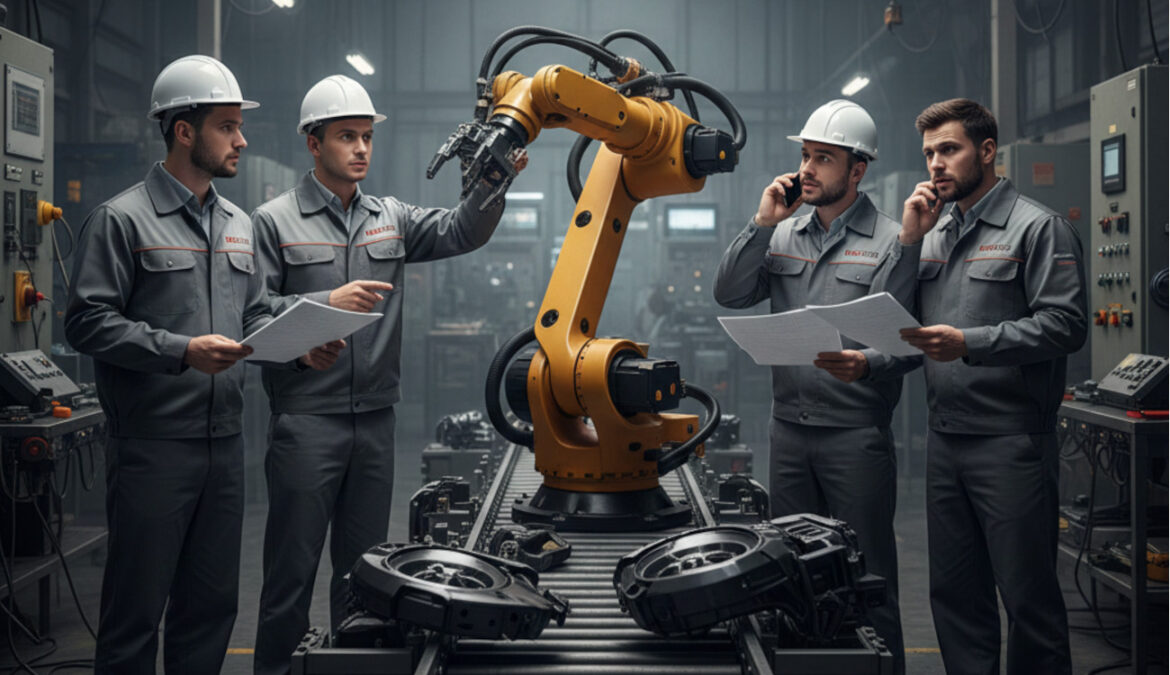
Understanding why most automation projects fail is the first step toward industrial success.
Automation promises efficiency, consistency, and relief from chronic labor shortages. Yet for many manufacturers, the first attempt at automation delivers something very different: delays, cost overruns, frustrated teams, and equipment that never quite reaches its expected performance.
This isn’t an exception – it’s a pattern. Companies often believe they’re buying a solution. In reality, they’re buying a mirror. Automation doesn’t hide weaknesses in a process. It exposes them.
And that’s why so many first‑time automation projects fail.
In This Article
The Expectation Gap: When Technology Meets Reality
Most automation journeys begin with optimism. A robot is purchased. An integrator promises smooth deployment. A timeline is drafted.
But the shop floor rarely follows the script.
A study by Boston Consulting Group shows that up to 70% of digital transformation projects fail to meet their goals. Automation is no different. And the reasons are rarely technical. Robots work. Sensors work. Software works.
The friction comes from everything around the technology – the processes, the people, the data, and the culture.
Watch this deep dive into why 70% of digital transformations fail and the strategies needed to join the successful 30%:
6 Common Reasons Why Automation Projects Fail
1) Why Automation Projects Fail on Unstable Processes
One of the most common mistakes is automating a process that is fundamentally unstable.
A European automotive supplier learned this the hard way. They installed a robotic assembly cell, only to discover that the upstream process produced parts with inconsistent tolerances. A human operator could “feel” the difference. The robot couldn’t. It jammed. Constantly.
The project stalled until the entire workflow was redesigned. Only then did automation make sense.
Automation amplifies whatever it touches – efficiency or chaos.
2) Underestimating Integration Complexity
Many first‑time adopters see the robot as the solution. In reality, it’s just one node in a much larger system.
A robot must communicate with conveyors, sensors, PLCs, safety systems, MES platforms, and sometimes ERP software. If even one connection is poorly defined, the entire system becomes fragile.
Integrators from Siemens, ABB, and FANUC often warn clients that 60–70% of the real work is integration, not the robot itself. But newcomers tend to focus on the hardware – the visible part – and underestimate the invisible engineering beneath it.
3) Lack of Internal Skills and Ownership
Many automation projects fail not because the integrator did a poor job, but because the company cannot maintain the system afterward.
A mid‑sized plastics manufacturer in the US installed a robotic palletizer. It worked flawlessly during commissioning. Six months later, small issues accumulated – a misaligned sensor, a worn gripper pad, an alarm no one understood. Production slowed. The robot was sidelined.
The root cause? No one had been trained to own the system.
Automation without internal capability is dependency, not transformation.
When a company lacks the expertise to troubleshoot minor issues, even the best-designed automation projects fail shortly after the integrators leave the site.
As we discussed in our article about the Hybrid Workforce, the bridge between human skills and machine precision is critical.
4) Workforce Resistance
Technology doesn’t fail in isolation. It fails in a culture.
Operators may fear job loss. Technicians may feel threatened by unfamiliar tools. Supervisors may worry about losing control over processes they’ve mastered for years.
Toyota avoids this problem by involving frontline workers from day one. Operators help design fixtures, test prototypes, and refine workflows. Adoption becomes smoother because the technology reflects real operational needs.
Where workers feel excluded, automation becomes an adversary. Where they feel included, it becomes an ally.
5) Poor Data Quality (or No Data at All)
Automation thrives on data – cycle times, tolerances, failure modes, throughput patterns. But many factories still rely on tribal knowledge and handwritten logs.
A UK food processing plant attempted to implement predictive maintenance using vibration sensors. The system failed to produce meaningful insights because the baseline data was incomplete and inconsistent. The technology wasn’t the problem. The data was.
As one engineer put it: “You can’t predict the future if you don’t know what ‘normal’ looks like.”
6) How Unrealistic ROI Makes Automation Projects Fail
Vendors often promise rapid payback – sometimes in under a year. But real‑world ROI depends on:
- Process stability
- Workforce readiness
- Integration complexity
- Maintenance maturity
- Product variability
A McKinsey analysis found that only 28% of automation projects achieve their projected ROI on schedule.
Automation isn’t magic. It’s an investment – and like any investment, it requires time, iteration, and learning.
How Companies Recover (and Eventually Succeed)
The good news? Most companies do recover. And the first failed project often becomes the turning point that leads to long‑term success.
Learning from the reasons why automation projects fail is the first step toward building a resilient, tech-driven production line.
Here’s how the most resilient manufacturers bounce back.
1) They Fix the Process Before Automating It
Instead of forcing technology onto a flawed workflow, successful companies step back and redesign the process. They simplify. Standardize. Remove variation.
Only then do they reintroduce automation.
2) They Start Smaller the Second Time
After a painful first attempt, companies often shift to pilot projects:
- One cell
- One workflow
- One team
- One product
Small wins build confidence and reveal hidden issues early.
3) They Invest in People, Not Just Machines
Training becomes a strategic priority:
- Internal academies
- Cross‑training programs
- Hybrid operator‑technician roles
- Mentorship from integrators
- Micro‑credentials in robotics and automation
Companies that succeed treat automation as a human transformation, not a technological one.
4) They Build Internal Ownership
Instead of relying entirely on external integrators, successful manufacturers develop internal champions – technicians, engineers, and operators who understand the system deeply.
These people become the backbone of future automation efforts.
5) They Redefine Success Metrics
Instead of chasing unrealistic ROI, companies shift to more grounded KPIs:
- Reduced downtime
- Improved consistency
- Safer workflows
- Lower scrap rates
- Faster changeovers
ROI follows naturally once the foundation is solid.
The Real Lesson: Automation Doesn’t Fail – Expectations Do
Most first‑time automation projects fail not because of the robots, but because of organizational blind spots. They are organizational ones. They stem from assumptions, blind spots, and the belief that a robot can fix a process that people haven’t fully understood.
- But companies that learn from these early missteps emerge stronger.
- More disciplined.
- More data‑driven.
- More collaborative.
And when they try again – with clearer goals, better processes, and a trained workforce – automation becomes what it was always meant to be: a force multiplier.
The future belongs to manufacturers who treat automation not as a purchase, but as a journey.