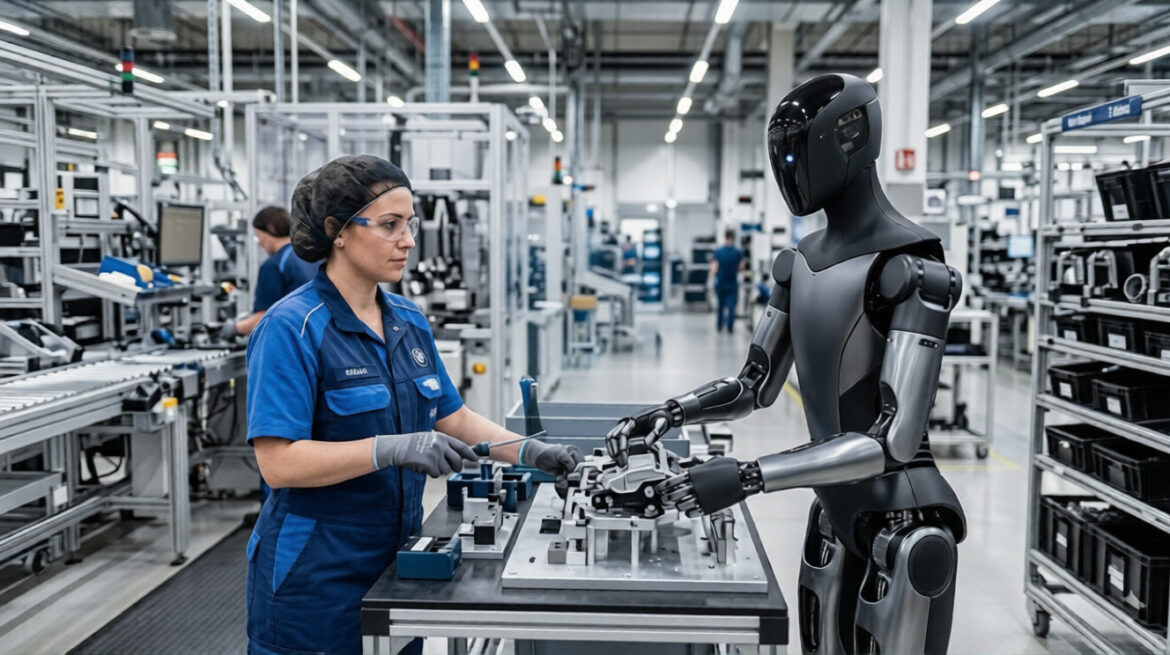
A few years ago, videos of robots doing backflips or dancing under stage lights felt like entertaining demonstrations, clever engineering tricks with little connection to the real pace of industrial work. Today the picture looks very different. Figure 02 is already working alongside operators on BMW’s production lines, and Tesla’s Optimus Gen 3 is entering serial manufacturing. These are not lab experiments anymore. They are the first real steps toward integrating Humanoid Robots into logistics and manufacturing.
This shift didn’t happen overnight. Industry rarely moves through “revolutions.” It evolves slowly but steadily, through pilots, incremental improvements, and accumulated experience. And right now, Humanoid Robots have reached a point where they can take on tasks that were previously too unpredictable for traditional industrial automation. That raises the obvious question: will they become colleagues or competitors for the people working on the factory floor?
In This Article
Early Deployments: What’s Actually Working Today
The clearest sign that Humanoid Robots are entering industry is that companies are no longer showing them only on stage, they’re putting them into real workflows, with real people and real constraints.
Figure 02 at BMW
During the first trials, operators watched Figure 02 with a mix of curiosity and caution. The robot placed components with millimeter‑level tolerance, moved parts between stations, and adapted to small variations in position. One engineer noted that the most surprising moment was when the robot stepped slightly aside to avoid blocking a passing worker. This was a clear example of “physical AI”, a system responding to real‑world context, not just executing code.
Digit by Agility Robotics in Amazon facilities
Digit already supports night shifts in logistics centers, moving empty totes, a task that is both monotonous and essential for material flow. A supervisor described the first days like this: “It wasn’t impressive as a show, but it was impressive as work.” Humanoid Robots like Digit fill exactly this gap: tasks humans struggle to sustain, and automation couldn’t handle until now.
Tesla Optimus
Optimus Gen 3 features redesigned hands with 50 actuators, enabling it to handle small tools and components with surprising finesse. In a test environment, engineers watched it pick up a screwdriver, rotate it slightly to position it correctly, and begin working. That was the moment it became clear that Humanoid Robots are no longer just “pick and place” machines, they can operate at stations originally designed for humans.
What Has Actually Changed: From Scripted Machines to Adaptive Systems
For decades, industrial robots were incredibly precise but painfully rigid. They followed predefined instructions. If an object wasn’t exactly where it was supposed to be, the robot stopped. That made them unsuitable for logistics, where environments are dynamic and tasks shift constantly.
Humanoid Robots operate differently. They rely on Vision‑Language‑Action (VLA) models, systems that combine visual perception, natural‑language understanding, and motor control. This allows them to recognize objects in real time, understand instructions phrased in everyday language, and adjust their actions if something changes, a person walks by, a box shifts, a tool falls slightly out of place.
This doesn’t make them “intelligent” in the way we understand human intelligence, but it makes them flexible enough to function in environments that are far from perfectly structured. And logistics is rarely perfectly structured.
Colleagues or Competitors: What This Means for Workers
The question of whether Humanoid Robots will replace people is natural. But the reality is more nuanced.
They take on tasks that we, humans, struggle to sustain
Heavy, repetitive, awkward, or dangerous activities are the first tasks Humanoid Robots are designed to handle. This isn’t “taking jobs away”; it’s relieving us from work that leads to injuries, fatigue, and high turnover.
Labor shortages are global
Logistics and manufacturing face chronic staffing shortages. Many companies struggle to find enough people for night shifts or low‑value repetitive tasks. Humanoid Robots fill exactly this gap.
Roles evolve rather than disappear
The introduction of humanoids creates new roles, robot system operators, maintenance technicians, process optimization specialists. It mirrors the shift from manual machining to CNC: the work doesn’t vanish; it transforms.
Economic pressure is real
Labor is one of the largest global costs. Low‑value repetitive tasks are always the first to be automated. Humanoid Robots simply extend automation into areas where fixed robots were too inflexible.
At this stage, humanoids are not “taking” our jobs. They are taking on work that is difficult for us, humans, to fill sustainably.
What Factories and Logistics Centers Gain
Humanoid Robots have one major advantage: they can work in environments designed for humans.
This means:
- No major infrastructure changes;
- They use the same walkways, tools, and workstations;
- They can be reassigned between tasks;
- They handle variability better than fixed automation.
This makes them far more flexible than traditional industrial robots, which are powerful but immobile. For logistics, where processes shift and volumes fluctuate – this flexibility is a major advantage.
The Limitations That Shouldn’t Be Ignored
Despite the progress, Humanoid Robots still have limitations.
- Their reliability is not yet on par with industrial robots;
- Costs remain significant, though decreasing;
- Some tasks still require specialized machinery;
- Worker acceptance and training are essential for successful deployment.
This is early‑stage technology entering real operations. But the direction is clear.
Where the Sector Is Heading: The Next 3-5 Years
The global market for Humanoid Robots is growing rapidly. Investment is rising, and companies across the US, Europe, and Asia are accelerating development. Logistics will likely be the first sector to feel large‑scale adoption – not because it’s trendy, but because the operational need is real.
In the coming years, we can expect:
- The first logistics centers where Humanoid Robots support full shifts;
- A drop in cost that makes adoption economically viable;
- A clearer division between tasks for workers and tasks for robots;
- New roles focused on supervision, maintenance, and optimization of robotic processes.
And perhaps most importantly, we’ll see more scenes where humans and robots work side by side.
One engineer described such a moment like this:
“When you see a robot step aside so it doesn’t get in your way, you realize automation is no longer just mechanics. It’s a new kind of collaboration.”
Humanoid Robots won’t replace us entirely. But they will become part of the team, colleagues who take on the heavy, repetitive, and risky work, while the staff focuses on supervision, analysis, and process improvement.
The shift has begun. The question now is how quickly industry will adapt its workflows to unlock the full potential of these new machines.
Technical Glossary
| Term | Brief Description |
| VLA Models | AI systems that integrate Vision, Language, and Action into a single robotic “brain.” |
| Physical AI | Artificial intelligence that enables a machine to perceive and react to the physical world in real time. |
| Actuator | The motor or mechanical component responsible for moving the robot’s joints and limbs. |
| Cobot | Short for “Collaborative Robot”-a machine designed to work safely alongside humans. |
| Rigid Automation | Traditional systems that follow a fixed script and cannot adapt to changes in their environment. |