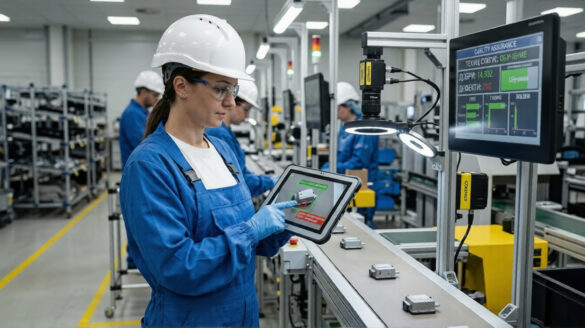
Industry 4.0 automated the factory floor. Machines began communicating with each other, robots took over heavy operations, and data became the new production resource. Yet despite all the technological breakthroughs, one part of manufacturing remained out of reach for algorithms: the human sense of quality. An experienced operator could spot a defect that a camera missed, feel a deviation that sensors didn’t register, or make a judgment that didn’t fit neatly into a rulebook.
This is where Industry 5.0 begins. It is the evolution in which factories don’t just automate – they humanize technology. The operator is no longer a passive observer but a mentor. The human is not the last checkpoint but the first source of knowledge. And artificial intelligence is not a replacement but a learner, absorbing the expertise of the best craftsmen on the line.
In this new era, the digital mentor emerges – an AI system that captures human experience, enhances it, and turns it into a continuous, scalable standard of quality.
In This Article
The operator’s new role in Industry 5.0
In many manufacturing environments, operators possess skills that cannot be fully documented. They recognize defects by subtle cues – a shade of color, a texture change, a microscopic irregularity. This intuition is built over years and is difficult to transfer.
Intelligent vision systems are changing that. They can now be trained the same way a new colleague would be. The operator demonstrates, the algorithm learns. The human sets the standard, the machine follows. This is the essence of Industry 5.0: technology amplifying human capability rather than replacing it.
How a digital craftsman is trained
Deploying AI vision is not a software installation – it is a learning journey. It unfolds in three key phases that transform a camera from a sensor into a digital apprentice.
1. Data labeling: digitizing human expertise
The operator reviews images from high‑speed cameras and labels defects such as scratches, color deviations, missing components, deformations, or contamination. This is the moment when tacit knowledge becomes structured data. The algorithm begins to understand what “good” and “bad” truly mean.
2. Shadow mode: the trial period
After initial training, the AI runs in parallel with the operator but does not intervene. It predicts; the operator confirms. When the system reaches a 99% match with expert decisions, it is ready for autonomous operation – its digital “baptism by fire.”
3. Active re‑training: a system that never stops learning
Even after going live, the system continues to learn. When it encounters a new, unfamiliar defect, it isolates it and asks the operator for guidance. This continuous loop of feedback is the core of Industry 5.0 – a partnership where the machine evolves alongside the human.
Real examples of AI vision in action
Intelligent vision is already reshaping multiple sectors. These real-world cases show how Industry 5.0 works in practice.
Pharmaceuticals: Bosch Packaging Technology
In ampoule and vial production, micro‑cracks are critical. Bosch uses AI vision systems that detect defects invisible to traditional sensors. The results include higher safety, reduced scrap, and fewer human errors.
Food processing: TOMRA
TOMRA systems analyze not only the shape but also the chemical composition of fruits. They assess ripeness, texture, and internal defects at the very start of the line. This leads to better quality, less waste, and improved traceability.
Textiles and luxury goods
In high‑end textile production, a single faulty thread can cost thousands of euros. Intelligent cameras stop the loom the moment a deviation appears, ensuring minimal scrap and consistent quality.
Electronics: Foxconn
Foxconn uses AI vision to detect micro‑defects in printed circuit boards – something nearly impossible for the human eye at speeds of 60,000 components per minute.
Edge AI as the brain on the line
For intelligent vision to be effective, decisions must be made in milliseconds. That is why modern production lines rely on Edge AI – local industrial computers that process data directly on the machine.
Common technologies include:
This architecture enables zero latency, higher accuracy, reduced network load, and improved security. Edge AI is the backbone of Industry 5.0 – intelligence that lives directly on the production line.
Quality that pays off
The shift to AI‑based quality control delivers measurable business value.
- Reduced scrap: Early defect detection prevents wasted labor and materials.
- Full traceability: Every AI decision is logged, supporting audits and certifications.
- Better use of human talent: Operators focus on process improvement rather than repetitive inspection.
- Faster onboarding: The AI system becomes a living “training manual” for new employees.
Humans and machines as partners
Industry 5.0 is not a vision of empty factories. It is a vision of factories where technology amplifies human capability. The operator is no longer just an executor – they are the architect of quality. AI is not a replacement – it is a digital apprentice learning from the best.
This is the new role of the human in Industry 5.0: turning the machine into a master.