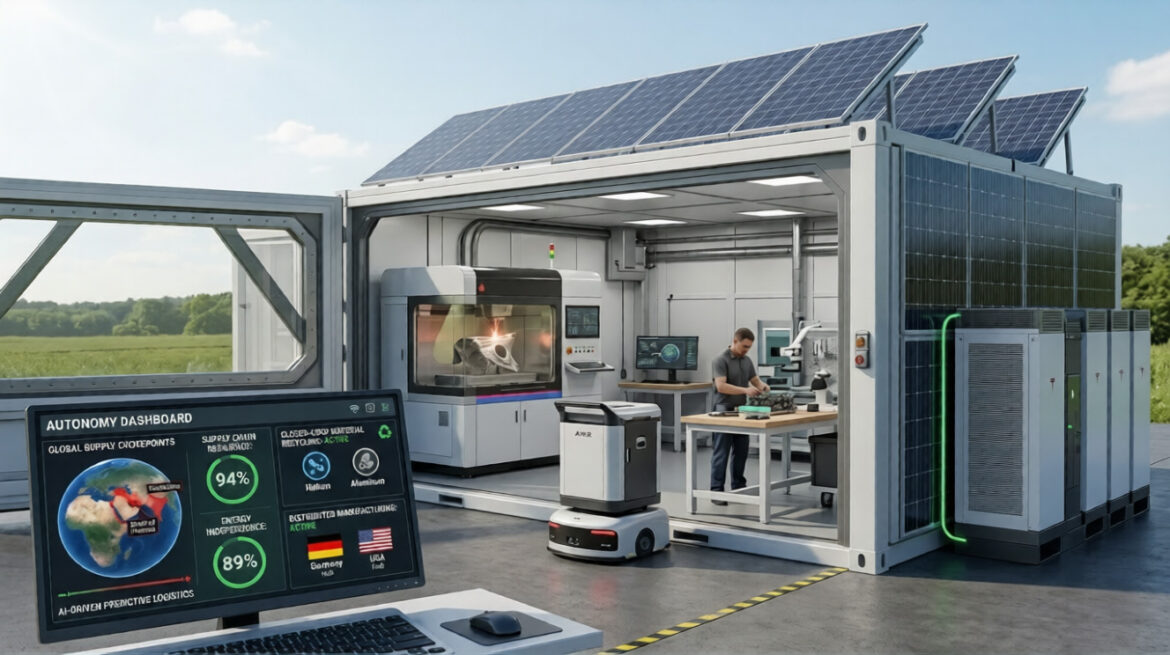
Industrial Autonomy is no longer a futuristic concept-it has become a strategic necessity. As geoeconomic confrontation and chokepoint disruptions fracture global supply chains, a new era of self‑sufficient, AI‑driven industrial systems is rising.
The shift from automation to true autonomy is already being mapped by industry leaders. As Yokogawa’s ‘IA2IA’ framework demonstrates, the journey involves moving beyond pre-programmed tasks toward systems that can learn, adapt, and self-optimize in real-time [02:41].
In This Article
When a Strait Becomes a Fault Line
When tankers slow down in the Strait of Hormuz, the shockwaves don’t hit consumers first – they hit factories.
In semiconductor cleanrooms where EUV lithography depends on ultra‑pure helium. In aviation manufacturing lines where aluminum is as critical as jet fuel. In logistics hubs whose schedules rely on maritime routes that can be disrupted in hours, not days.
Hormuz is only one of fourteen global chokepoints that keep the industrial world vulnerable. But the 2026 tensions around it revealed something deeper: modern industry cannot rely on geopolitical stability as a prerequisite for operation.
The World Economic Forum now defines this era as one of geoeconomic confrontation – a term that sounds academic but translates into a simple operational truth:
Every company must be able to function even when the world around it doesn’t.
This is the foundation of a new paradigm: Industrial Autonomy.
Not isolation. Not reshoring. A new architecture where factories can operate, adapt and supply themselves even when global systems fracture.
The Helium & Aluminum Shock: The Crisis Behind the Headlines
While headlines focus on oil prices, industry leaders watch different charts – the ones tracking helium and aluminum.
Helium: the invisible oxygen of modern manufacturing
Helium is not just a gas. It is a critical enabler for:
- EUV lithography in semiconductor fabs
- Cooling of MRI systems
- Aerospace and rocket engineering
- Fiber‑optic production
- Cryogenic research
Over 70% of global helium flows through routes linked to the Persian Gulf. When those routes slow down, fabs don’t just pay more – they halt.
Real example: During the 2022 helium shortage, Intel and TSMC were forced to deploy aggressive helium‑recycling systems after global supply contracted by more than 30%. What began as a contingency measure is now standard practice.
Aluminum: the metal that keeps aviation in the air
Aluminum is the backbone of:
- Aircraft manufacturing
- Automotive production
- Energy infrastructure
- Construction and transport systems
When shipments from the Gulf slow down, the domino effect is immediate. Airbus has already expanded its closed‑loop recycling programs, enabling high‑grade aluminum recovery from retired components — not for sustainability branding, but for supply security.
The Technological Response: Driving Industrial Autonomy
The crisis is accelerating adoption of:
- Helium recovery systems achieving up to 90% reuse
- Closed‑loop aluminum reprocessing through local mini‑refineries
- Alternative lithography gases such as argon‑based processes
These are not environmental initiatives. They are industrial survival systems.
Distributed Manufacturing: From Global Chains to Local Micro‑Factories
Global supply chains were engineered for efficiency. Today, companies prioritize resilience.
Micro‑factories: production moves closer to demand
Micro‑factory models enable:
- Small‑batch production
- Local spare‑parts manufacturing
- Reduced dependency on international shipping
- Rapid adaptation to market changes
Real example: BMW now uses additive manufacturing for more than 3,000 components, including spare parts that previously arrived from Asia. Today, they are produced in local hubs in Germany and the United States.
These local hubs are more than just production sites; they are the physical manifestation of industrial autonomy in action, reducing reliance on broken global links.
3D printing: spare parts in hours, not months
When ships reroute around Africa, transit times extend by 10-14 days. For many industries, that delay is unacceptable.
Companies using Formlabs, Stratasys and Markforged systems now:
- Print tooling
- Print replacement parts
- Print prototypes directly on‑site
Distributed manufacturing is not a futuristic concept. It is a practical response to a fractured world.
Energy as a Service (EaaS): Autonomy in a $120 Oil World
Energy independence is a core pillar of industrial autonomy. When oil prices fluctuate, decentralized energy models allow factories to maintain operational stability.
Decentralized energy becomes an industrial standard
EaaS enables factories to operate as energy nodes, not passive consumers. The model integrates:
- Local renewable generation
- Industrial‑scale battery systems
- Energy‑balancing software
- The ability to sell excess power back to the grid
Real example: Tesla Megapack installations are now used by manufacturers in California to stabilize operations during grid volatility and peak‑price periods.
Sustainability + Security = Industrial Autonomy
Sustainability is no longer a marketing narrative. It is a risk‑mitigation strategy.
Factories that generate, store and manage their own energy gain operational independence – a competitive advantage in an unstable world.
AI‑Driven Supply Chain Resilience: Predicting Disruptions Before They Happen
In an era of geoeconomic confrontation, supply chain visibility is no longer enough. Companies need predictive intelligence.
This level of predictive intelligence is the natural evolution of Industry 5.0 and human-machine collaboration.
AI that sees two weeks ahead
Modern AI systems can:
- Analyze maritime traffic patterns
- Detect early signals of disruption
- Simulate alternative logistics routes
- Recommend automatic rerouting
- Model supplier risk in real time
Real examples:
- Siemens uses digital twins to simulate and stress‑test supply networks
- Palantir Foundry models disruption scenarios for industrial clients
- SAP Business AI predicts supply chain bottlenecks based on historical and real‑time data
This is not optimization. This is industrial prevention.
The Future Starts Now: The New Industrial Map
The world is entering a period where industry cannot rely on stability. But it can rely on itself.
The transition toward industrial autonomy marks a fundamental shift in how we perceive manufacturing resilience.
Industrial Autonomy does not mean isolation. It does not mean turning away from global markets. It means building a new industrial architecture where:
- Factories are energy‑independent
- Production is local, modular and adaptive
- Materials circulate in closed loops
- AI predicts risks before they materialize
- Supply chains operate as networks, not linear dependencies
This is industry that does not wait for the world to calm down. It adapts to the world as it is.
The next five years will define the industrial landscape for the next fifty. And the companies investing in autonomy today will be the ones leading tomorrow.