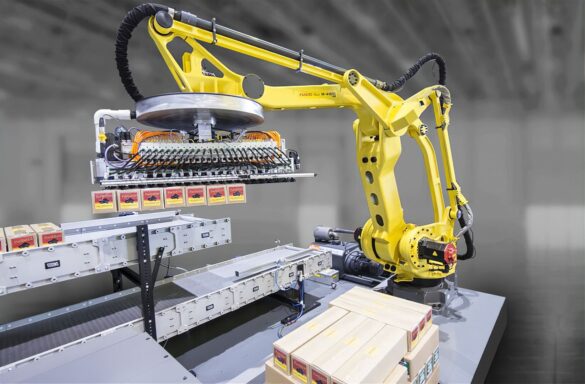
Every minute, thousands of pallets are stacked around the world. Some – slowly, manually, and with a high risk of error. Others – with surgical precision, constant speed, and almost zero deviation when coordinates are set correctly. The gap between these two worlds now defines the competitiveness of entire industries. Where pallets move without interruption, factories grow. Where the process slows down, growth contracts – and sometimes stops altogether. This is where strategic solutions like the FANUC M-410iC bridge the gap between manual labor and high-speed precision.
It is precisely in this final meter of the production line that one of the most significant transformations in modern industry is unfolding: robotic palletizing has risen from auxiliary automation to a strategic asset. It is no longer just a way to ease heavy manual labor – it is a technology that determines capacity, margins, resilience, and predictability. Among the solutions that clearly illustrate this shift is the FANUC M-410iC series – robots that set the benchmark for modern palletizing.
In This Article
Market Context: Why Robotic Palletizing Became a Critical Innovation Zone
A decade ago, palletizing automation was optional. Today, it is a necessity driven by several structural forces reshaping global manufacturing.
Labor shortages
Palletizing is physically demanding, repetitive, and often undesirable work. Across Europe, manufacturers struggle to retain staff in warehouse and logistics operations, with turnover in some sectors reaching 25–30% annually. Robots from the FANUC M-410iC series fill this gap by taking over the heaviest tasks and stabilizing production flows.
E‑commerce growth and the need for faster cycles
Online commerce has reshaped logistics. Pallets must be processed faster, more accurately, and with minimal errors. In major logistics hubs across Central Europe, robotic palletizing is already standard because it enables 24/7 operation without performance degradation.
Cost‑optimization pressure
Companies seek ways to reduce operational expenses, minimize errors, and increase capacity without expanding floor space or headcount. ROI for robotic palletizing typically ranges from 18 to 30 months.
Industry 4.0 and the need for data
Palletizing robots are now part of connected ecosystems that generate data on performance, load, maintenance, and quality. This turns robotic palletizing into a strategic management tool rather than a simple automation step.
FANUC M-410iC: The New Standard in Robotic Palletizing
The FANUC M-410iC series includes several models, with the most widely adopted being the FANUC M-410iC/185 – a high‑speed, four‑axis robot optimized for heavy and intensive palletizing operations. FANUC has over 900,000 robots installed worldwide, and the M-410iC family is among the most commonly used solutions for palletizing.
Key advantages of FANUC M‑410iC
- Payload capacity up to 185 kg
- Reach up to 3,143 mm
- High cycle speed
- Four‑axis architecture optimized for vertical motion
- Energy efficiency and low maintenance costs
- Exceptional reliability and long service life
These characteristics have a direct impact on production economics.
Higher capacity without additional cost
In beverage plants in Poland, the M-410iC/185 performs 1,700+ cycles per hour, even when handling heavy cartons – a result nearly impossible to achieve manually.
Reliability as a business factor
In food processing facilities in Germany, M-410 series robots have been operating for more than 10 years with minimal intervention. This reduces unplanned downtime and boosts OEE.
Lower integration complexity
The four‑axis design is simpler than six‑axis robots, reducing integration and maintenance complexity — a major advantage for companies adopting robotic palletizing for the first time.
Economic Impact: How FANUC M-410iC Changes the Cost Model
Reduced labor costs
A single robot can replace between two and four operators depending on volume and shift structure.
Lower error rates
In logistics centers in the Czech Republic, robotic palletizing cells have reduced transport‑related product damage by over 40%.
Greater predictability
The robot operates at a constant pace, without fatigue or performance decline – essential for industries with tight delivery windows.
Improved OEE
FANUC M‑410iC maintains a stable rhythm, increasing the efficiency of the entire production line.
Integration into Industry 4.0: FANUC M-410iC in the Connected Factory
MES and ERP connectivity
The robot can receive tasks automatically, report status updates, and synchronize with production orders.
AGV/AMR integration
Combining robotic palletizing with autonomous mobile robots enables fully automated material flow from the production line to the warehouse.
ZDT (Zero Down Time) predictive maintenance
FANUC’s ZDT (Zero Down Time) service analyzes load, vibration, and cycle patterns to predict issues before they occur – reducing unplanned downtime and extending equipment life.
Software ecosystem: PalletPRO, PalletTool, iRPickTool
FANUC’s software suite allows manufacturers to simulate, configure, and modify palletizing patterns in minutes rather than hours. This flexibility is crucial in modern logistics, where frequent SKU changes are just as important as raw speed.
ESG Impact: Precision That Reduces Waste and Emissions
Robotic palletizing contributes directly to sustainability goals:
- Less stretch‑film consumption due to stable, repeatable pallet patterns
- Better truck‑load density, reducing the number of transport runs
- Lower carbon footprint across outbound logistics
- Fewer damaged goods, reducing waste and returns
For companies reporting under ESG frameworks, these improvements translate into measurable environmental benefits.
Market Examples: Who Benefits Most from FANUC M-410iC
Food and beverage industry
In dairy plants in Romania, robotic palletizing has reduced pallet processing time by 27%.
Logistics centers
In Hungary, robotic palletizing cells process over 2,000 pallets per day.
Construction materials
Heavy loads and dusty environments make robots ideal for this sector, reducing workplace injuries and increasing throughput.
Pharmaceutical and chemical industries
Precision and traceability are critical – FANUC M‑410iC ensures consistent quality and standardized pallet patterns.
Competitive Landscape: What Other Manufacturers Offer
- KUKA KR Quantec PA – high speed and energy efficiency
- ABB IRB 460/660 – optimized for fast cycles and compact cells
- Yaskawa MPL series – flexibility and easy integration
Market trends are clear:
- Higher speed
- Greater payload capacity
- Lower energy consumption
- Improved connectivity
FANUC M-410iC fits these trends perfectly – and often surpasses competitors in long‑term reliability and lifecycle stability.
Why It Matters
FANUC M-410iC is not just a palletizing robot – it is a strategic tool reshaping the economics of manufacturing and logistics. In the era of Industry 4.0, robotic palletizing is an investment in resilience, predictability, and competitiveness. Companies that adopt it today are building the foundation of the factory of the future – a factory that operates faster, smarter, and more reliably.
The question is no longer whether palletizing should be automated, but how quickly a company can integrate these solutions before falling behind the market curve.