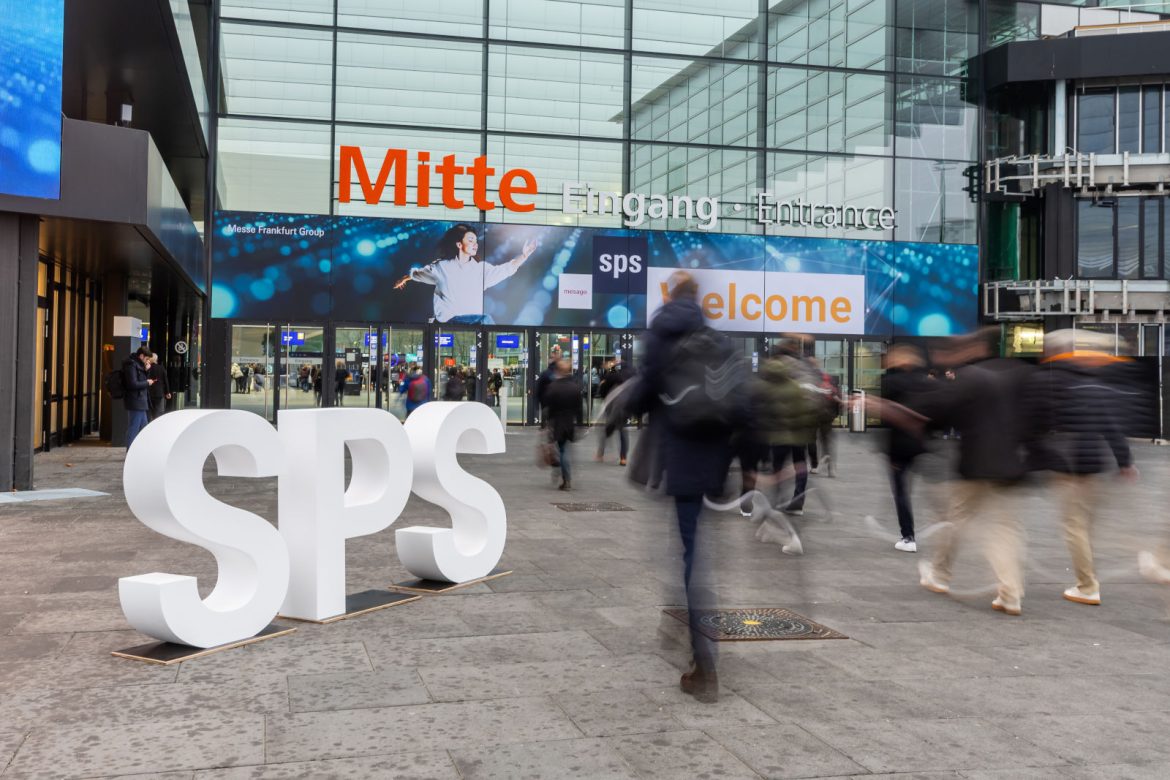
Fifteen exhibition halls. Hundreds of companies. Three days in Nuremberg.
When SPS 2026 opens its doors on November 24, the industrial automation industry will once again gather to demonstrate what it has been working on. Control systems, drives, sensors, robots, industrial software, cybersecurity and artificial intelligence will compete for attention. Some technologies will be familiar, others considerably newer. And, as always, there will be plenty of impressive demonstrations.
In This Article
But walk through an exhibition like SPS with a factory engineer’s perspective and a different picture begins to emerge.
The interesting question is not how many robots a company can put on its stand, how many functions a new controller offers or how convincingly a digital twin can reproduce a production process on a screen.
It is what happens when that technology leaves the exhibition hall.
A factory does not start from a clean sheet. It has machines of different generations, established engineering practices, production targets, maintenance teams and equipment that cannot simply be switched off while a new automation architecture is introduced. A promising technology has to find its place in that environment — and earn it.
That is what makes SPS worth exploring.
For the engineers, machine builders, production managers and manufacturers visiting Nuremberg, the exhibition offers an opportunity to look beyond individual products and understand how the different parts of industrial automation are coming together.
The following guide approaches SPS from that perspective. Not as a ranking of exhibitors or a catalogue of product announcements, but as a journey through the technologies that make a modern factory work.
Before the machine moves, someone has to engineer it
Every automated production process begins with engineering.
Long before a robot moves a component or a controller executes a sequence, someone has to design the machine, define its electrical architecture, select its components and make sure that all the pieces can work together.
This is an important place to begin at SPS because the decisions made during engineering often determine how much trouble a system will cause later.
EPLAN: The factory begins on the engineering screen
Hall 3C, Booth 521
EPLAN focuses on electrical engineering, automation planning, documentation and engineering data. Its technologies address a part of industrial production that is easy to overlook when attention is concentrated on the machines themselves.
Yet engineering data is what connects the original design to the equipment eventually installed on the factory floor.
When a machine is modified, when a component is replaced or when an entire production line is expanded, the quality and consistency of that information become extremely important. Outdated documentation and disconnected engineering systems can turn a relatively simple change into a lengthy exercise.
For machine builders, the challenge is particularly familiar. Electrical design, mechanical engineering, manufacturing, commissioning and service all need to work with information that remains consistent throughout the equipment’s lifecycle.
Digital engineering is often discussed as a way to accelerate design. Its practical value, however, goes further: it can help reduce the distance between what was designed, what was built and what the maintenance team eventually has to deal with.
At SPS, the useful conversation is about how engineering information moves between systems, how design changes are managed and whether digital tools can genuinely simplify the work of the people responsible for building and maintaining machines.
From there, the journey moves naturally to the systems that bring those designs to life.
The automation backbone: control, communication and motion
A modern factory can contain advanced robots, intelligent sensors and sophisticated software, but none of them operates in isolation.
Control systems coordinate machines. Communication networks connect equipment. Drives and motion systems translate commands into physical movement. The way these elements are designed and integrated determines how the production system behaves as a whole.
This is where the technologies of Siemens, Beckhoff and Bosch Rexroth become particularly relevant.
Siemens: Connecting the engineering world with production
Hall 7A, Booth 240
Siemens occupies a broad part of the industrial automation landscape, spanning control systems, industrial software, digital engineering and connected production.
At SPS 2026, industrial AI and digital engineering are among the company’s announced areas of focus.
There is an important distinction between demonstrating a digital capability and making it useful in a working factory. The latter depends on how well engineering data, automation systems and production information can be connected without creating another layer of complexity.
For manufacturers, this raises a practical set of questions. Can existing equipment be integrated? What changes are required in the engineering workflow? How is production information collected and managed? And what happens when equipment from different generations has to operate together?
These are not questions unique to Siemens. They are the questions that accompany almost every major automation investment.
The company’s presence across additional exhibition locations in Halls 11.0 and 11.1 also reflects the breadth of its industrial portfolio. Visitors interested in a particular technology should check the official SPS directory for the corresponding stand and programme information.
Beckhoff: When the controller becomes a computing platform
Hall 7, Booth 406
Beckhoff’s approach to PC-based control and EtherCAT provides a useful perspective on how control, communication and motion can be brought together within a machine architecture.
The company has announced SPS 2026 topics involving PC-based control, machine vision, AI and cabinet-free automation through its MX-System.
These technologies raise an interesting engineering question: how much of the traditional automation structure can be simplified, and what does that change for the people who design, commission and maintain the machine?
The integration of control and motion is particularly relevant to machine builders working with increasingly complex or modular equipment. A more integrated architecture can change the way systems are configured and commissioned, but it also places greater importance on software, engineering skills and system-level understanding.
For a factory, the decision is not simply whether a controller offers more computing power. It is whether the architecture fits the machine, the production process and the capabilities of the team responsible for keeping it running.
That is a conversation worth having at the Beckhoff stand.
Bosch Rexroth: Making motion work in the real production process
Hall 7, Booth 450
Motion control is one of those areas where the difference between a demonstration and an industrial application becomes immediately apparent.
A drive may perform exactly as expected on its own. In a production environment, however, it has to work with the controller, the mechanical system, the surrounding equipment and the process itself.
Bosch Rexroth’s technologies span drives, motion control and automation systems, making its stand relevant to engineers examining how these elements are integrated.
For manufacturers modernising existing equipment, compatibility is often as important as performance. A new motion system has to fit within the machine’s mechanical and electrical architecture, and it must be possible to commission and maintain it without introducing unnecessary complexity.
The same applies to new machine designs. The more closely motion, control and engineering are coordinated, the more important it becomes to consider the complete system rather than selecting components independently.
This is one of the recurring themes at SPS: the technology may be presented as a product, but the factory has to operate it as a system.
A factory cannot automate what it cannot reliably detect
Control systems need information. Robots need to know where objects are. Inspection systems need to distinguish acceptable products from defective ones. Machines need to identify components and understand what is happening around them.
That brings sensing and machine vision into the picture.
SICK: From physical conditions to usable information
Hall 7A, Booth 340
SICK’s portfolio includes industrial sensors, machine vision, identification and safety-related technologies.
It is an area where the industrial environment matters enormously.
A sensor that performs well under controlled conditions may face a very different task in a foundry, a dusty workshop or a production line where vibration, temperature changes and inconsistent positioning are part of everyday operation.
The same applies to machine vision. The question is not simply whether a camera can recognise an object during a demonstration. It is how consistently the system can deliver useful information when products, lighting conditions and production conditions vary.
This becomes even more important as sensing technologies are combined with software and AI-assisted analysis.
For manufacturers, the attraction is clear: better information can support inspection, identification, process monitoring and more flexible automation. But the usefulness of that information depends on its reliability and on how effectively it can be integrated into the control system.
SPS provides an opportunity to look at sensing not as an isolated component category, but as the point where the physical factory becomes visible to the systems controlling it.
And once machines can detect and interpret their surroundings, the next question is what they can do with that information.
Festo: Where physical automation meets digital engineering
Hall 9, Booth 305
Festo is particularly interesting because its technologies sit at the intersection of motion, control, engineering and digitalization.
Pneumatic and electric automation remain fundamental to industrial production. What is changing is the way these technologies are configured, controlled, monitored and integrated into larger systems.
Festo’s announced SPS 2026 programme includes Festo AX, digital engineering tools, the Asset Administration Shell, Smartenance and Motion Insights. The company is also presenting its CEPE control platform, remote I/O and electric automation technologies.
The range of topics reflects a broader development in automation: the physical equipment and the digital tools surrounding it are becoming more closely connected.
For an engineer, that connection is only useful if it solves a practical problem. Can a machine be commissioned more efficiently? Can equipment condition be monitored in a meaningful way? Can a system be modified without having to redesign large parts of the automation architecture?
Festo has also announced demonstrations involving synchronised motors and drives, a 7th-Axis-Robot-Display and digital twins.
These are worth examining in the context of complete applications. Coordinating multiple drives, for example, is not just a question of synchronisation. It involves the control architecture, the mechanical system, the engineering tools and the behaviour of the machine as a whole.
The same applies to digital twins. Their usefulness depends on what they represent, how accurately they reflect the physical system and whether the information they provide can improve engineering or production decisions.
Festo’s stand offers an opportunity to explore these connections between physical automation and digital tools — and to ask where they make a measurable difference to the work of a factory.
The connections that hold everything together
As machines become more connected, industrial communication and infrastructure move from the background to the centre of automation design.
A factory may contain controllers, sensors, drives, robots and software from multiple suppliers. All of them need to exchange information, and the network connecting them has to remain reliable, manageable and secure.
Phoenix Contact: Building the infrastructure for connected production
Hall 9, multiple booths
Phoenix Contact’s SPS presence covers industrial automation, connectivity, communication and digitalization.
Its technologies are relevant to engineers working on control systems, industrial networking and the connection between operational technology and IT.
The challenge is not simply to connect more devices. Every additional connection introduces questions about configuration, maintenance, access and security.
A network that works during commissioning also has to remain manageable as the factory expands, equipment is replaced and production requirements change.
Cybersecurity is part of the same discussion. Connecting industrial equipment creates responsibilities around network architecture, access management, monitoring and the handling of software updates.
For manufacturers, the objective is a communication infrastructure that supports production without making the system unnecessarily difficult to operate or maintain.
This is particularly important in factories where equipment from different generations and suppliers has to work together.
The practical conversation at SPS should therefore move beyond connectivity as a feature and focus on how industrial networks are designed, maintained and secured throughout their lifecycle.
More automation also means more responsibility
There is a temptation to treat safety as a separate subject, something to address once the machine design is nearly complete.
In practice, safety is part of the architecture from the beginning. It affects machine design, control systems, access, commissioning and every subsequent modification.
Pilz: Safety throughout the machine lifecycle
Hall 9, Booth 370
Pilz focuses on machine safety, safety sensors, identification and access management, Industrial Security and lifecycle management.
At SPS 2026, the company is presenting its MYZEL Lifecycle Platform.
The subject is particularly relevant as production equipment becomes more flexible and connected. Machines are modified, production lines are reconfigured and people interact with automated systems in different ways.
Safety therefore cannot be considered only at the moment a machine is installed. It has to be managed throughout the equipment’s operating life.
For engineering teams, that means understanding how safety functions are implemented, how changes are assessed and documented, and how the machine remains compliant as its configuration evolves.
Industrial Security adds another dimension. The protection of connected equipment and the management of access are increasingly linked to the safe and reliable operation of production systems.
The important point is that automation does not eliminate engineering responsibility. It changes the nature of that responsibility and makes coordination between safety, control and security more important.
Robotics: the machine has to do more than move
Robots remain among the most visible technologies at industrial exhibitions. They are also among the easiest to misunderstand when they are viewed outside the production process they are intended to serve.
A robot’s performance depends on much more than its movements. It has to be integrated with tooling, machines, safety systems, control architecture and the process itself.
FANUC: Robotics, CNC and the wider production system
Hall 4, Booth 259
FANUC brings together industrial robotics, CNC systems, drives and factory automation technologies.
Its SPS 2026 information includes the FS500i-A CNC and Digital Servo Adapter-Model B.
The combination of robotics and CNC is particularly relevant to manufacturers looking at automated machining, machine tending and the coordination of equipment across a production process.
A robot may be capable of handling a component quickly and accurately. But the actual production result depends on whether the surrounding machine is ready, whether the component can be positioned consistently and whether the entire sequence meets the required cycle time.
Programming, tooling, integration and safety all contribute to the final outcome.
For factory engineers, the interesting discussion is therefore not just about robot specifications. It is about how the robot fits into the machine or production line, how it communicates with surrounding equipment and how it can be maintained once the system is in operation.
This is also where the wider automation architecture becomes visible. Robotics is not an isolated destination at the end of the factory’s development. It is one part of a connected production system.
Hall 6: Where industrial automation meets IT and new ideas
Not every relevant technology at SPS comes from an established automation supplier.
Some of the developments worth watching emerge where industrial engineering meets software, data and new approaches to production.
Hall 6 offers visitors a chance to explore that intersection.
Automation meets IT
Hall 6, Booth 350
The Automation meets IT area covers industrial IT, cloud and edge computing, cybersecurity, IoT and AI.
These technologies are becoming increasingly relevant as manufacturers look for ways to use production data beyond individual machines and control systems.
But moving data between the factory floor and IT platforms raises questions that cannot be answered by a software demonstration alone.
Where is the data processed? What happens if the connection is interrupted? How does the system handle access, security and the requirements of production?
For a factory, the distinction between operational technology and IT remains important, even as the two become more closely connected.
The most useful demonstrations are those that explain how a technology addresses a specific industrial problem, what infrastructure it requires and how it behaves under real operating conditions.
Start-up Area
Hall 6, Booth 255
The Start-up Area brings together younger companies developing automation technologies.
For visitors, it offers a chance to discover approaches that may not yet be widely represented in established industrial portfolios.
New companies can bring fresh ideas to problems that manufacturers have been dealing with for years. But an interesting concept and an industrially deployable solution are not the same thing.
It is worth asking what problem the technology solves, whether it has been used in a production environment and what would be required to integrate it into existing equipment.
Questions about technical support, long-term availability and system compatibility are just as relevant here as they are when speaking with established suppliers.
young INNOVATORS
Hall 6, Booth 251
The young INNOVATORS area provides another opportunity to discover emerging automation technologies from young German companies.
It is a useful reminder that industrial innovation does not come exclusively from the largest exhibitors.
For factory engineers, the same practical questions apply: What does the technology actually do? Which industrial problem does it address? How far has it progressed beyond the development stage?
The value of these areas is not that every new idea will become an industrial product. It is that visitors can see different approaches to manufacturing challenges and consider whether any of them might have a place in their own operations.
Finding your way through SPS in one day
Three days may sound like a reasonable amount of time for an exhibition, but fifteen halls can quickly make even a carefully planned visit feel short.
The answer is not to walk faster. It is to know what you are looking for.
For a visitor primarily interested in engineering and control architecture, starting in Hall 3C and moving towards Hall 7 makes sense. Those interested in sensing and machine vision can continue to Hall 7A, while Hall 9 brings together motion, connectivity and safety technologies.
Robotics-focused visitors will want to allow time for Hall 4, while Hall 6 is worth including for industrial IT, AI and emerging automation solutions.
A possible route through selected exhibitors is:
| Area | Companies and topics |
|---|---|
| Hall 3C | EPLAN: Engineering, electrical design and documentation |
| Hall 7 | Siemens, Beckhoff, Bosch Rexroth: Control, communication and motion |
| Hall 7A | SICK: Sensing, machine vision and identification |
| Hall 9 | Festo, Phoenix Contact, Pilz: Motion, connectivity and safety |
| Hall 4 | FANUC: Robotics, CNC and factory automation |
| Hall 6 | Automation meets IT, Start-up Area and young INNOVATORS |
This is a thematic route, not a precise walking-time itinerary. The official floor plan and exhibitor directory should be checked before the visit, particularly for additional company locations and programme changes.
More importantly, visitors should leave enough time for conversations. A short discussion with an engineer about integration, limitations or a real application may be more useful than seeing several additional demonstrations.
If you are visiting with a specific project in mind, it is worth identifying the relevant exhibitors in advance and arranging meetings where possible.
The purpose of the visit is not to collect the largest number of impressions. It is to come away with information that can be used.
A route through the modern factory
There is a useful way to connect the different areas of SPS without treating them as separate technology categories.
Think of the exhibition as a journey through the architecture of a modern factory:
Engineering → Control → Communication → Sensing → Motion → Robotics → Safety → Software → AI
It is not a universal blueprint. Every factory has its own processes, equipment and requirements, and no single sequence describes every automation architecture.
But it provides a way to understand how the technologies relate to one another.
Engineering establishes how the equipment is designed and documented. Control coordinates machine functions, while communication connects devices and systems. Sensing provides information about the physical process. Motion turns commands into movement, and robotics brings together motion, sensing and programming to perform production tasks.
Safety determines the conditions under which machines and people can operate. Software connects engineering, monitoring and production information. AI introduces additional possibilities for analysing data, supporting decisions and adapting selected processes.
The connections between these areas are often more interesting than the technologies considered individually.
A sensor becomes more useful when its data can be reliably integrated into a control system. A robot becomes more valuable when it can be incorporated into a production process without creating unnecessary complexity. Industrial AI depends on the quality of the underlying data, the systems providing it and the problem the technology is expected to solve.
This is why the factory, rather than the individual product, should remain the reference point.
The questions worth taking to the exhibition
For anyone responsible for industrial equipment, the most useful conversations at SPS will often begin with a specific production problem.
A new technology may offer more functionality, better connectivity or a different approach to automation. But its relevance depends on the environment in which it has to operate.
How does it integrate with the machines already installed? Does it require replacing equipment that is still working? How much engineering effort is needed to commission it? What skills will the maintenance team need?
Reliability deserves the same attention as functionality. A demonstration can show what a system is capable of under particular conditions. A factory needs to know how it performs over time, how faults are diagnosed and what happens when something goes wrong.
There is also the question of cost. The purchase price is only one part of an automation investment. Integration, training, maintenance, downtime and future modifications all contribute to the economics of a solution.
And then there is safety and security. As machines become more connected and production systems more flexible, these requirements have to be considered alongside performance and productivity.
None of these questions is particularly glamorous. All of them matter.
A technology that solves a genuine production problem and can be integrated, maintained and operated reliably may be more useful to a factory than a much more sophisticated system that introduces complexity without delivering a clear benefit.
That is not an argument against innovation. It is a reminder of what innovation ultimately has to achieve in manufacturing.
The factory remains the final measure
SPS 2026 will bring together companies working across industrial automation, from established control and motion technologies to robotics, industrial software and AI.
The exhibition provides an opportunity to see technologies directly, speak with the people developing them and compare different approaches to the challenges facing manufacturing.
But the value of a visit will not be determined by the size of the stands or the number of demonstrations seen.
It will depend on what a factory can take away from the experience — a better understanding of a technology, a solution to an engineering problem or a clearer idea of how an existing production process can be improved.
Ultimately, the value of SPS 2026 will not be measured by how many technologies a visitor sees, but by how many of them make sense for the factory they are trying to build, improve or keep running.
SPS 2026: Visitor information
Event: SPS — Smart Production Solutions
Dates: November 24–26, 2026
Location: Nuremberg Exhibition Center, Nuremberg, Germany
Opening hours for trade visitors:
- Tuesday, November 24: 9:00 a.m. – 6:00 p.m.
- Wednesday, November 25: 9:00 a.m. – 6:00 p.m.
- Thursday, November 26: 9:00 a.m. – 5:00 p.m.
The exhibition is open to trade visitors aged 14 and above.
For the latest exhibitor locations, hall layouts, tickets and programme updates, consult the official SPS website and digital exhibitor directory before travelling.
Official resources:
- SPS official website: https://sps.mesago.com/nuernberg/en/expo.html
- Exhibitor search: https://sps.mesago.com/nuernberg/en/exhibitor-search.html
- Hall and site planning: https://sps.mesago.com/nuernberg/en/expo/planning-preparation/venue-site.html
- Opening hours: https://sps.mesago.com/nuernberg/en/expo/planning-preparation/opening-hours.html
Editorial note: Exhibitor locations and product demonstrations may change. Confirm individual stand details and programme information in the official SPS directory before your visit.