In This Article
The race to make industrial robots genuinely intelligent is moving into a new phase, and Vention wants to be part of the infrastructure behind it.
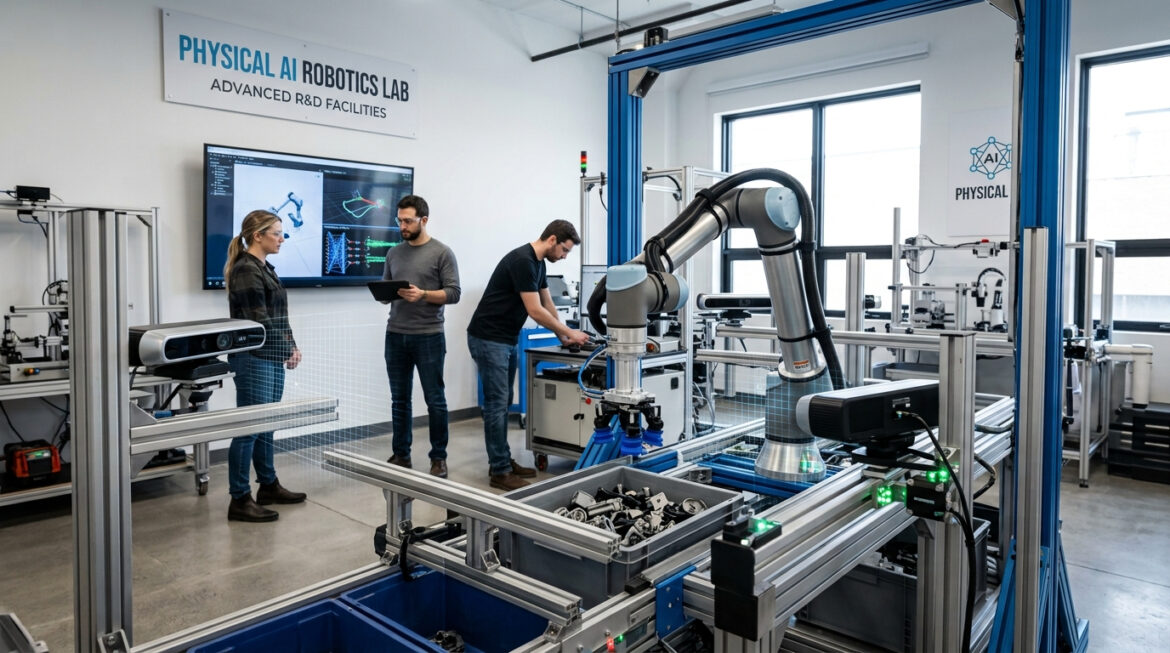
The Montreal-based industrial automation company has opened a new Physical AI laboratory dedicated to robotic manipulation, with a clear objective: move advanced AI robotics research out of controlled demonstrations and into factories where reliability, cost and repeatability matter far more than impressive laboratory results.
That distinction is becoming increasingly important as Physical AI technology moves from experimental projects toward real-world industrial applications.
For years, industrial robots have been exceptionally good at performing repetitive tasks under tightly controlled conditions. Their strength has been precision and predictability. Their weakness has been adaptability. Change the position of an object, introduce an unfamiliar component or alter the environment, and a system built around conventional programming can quickly reach its limits.
Physical AI is attempting to change that equation.
Instead of telling a robot exactly how every movement should be performed, Physical AI systems are designed to allow machines to perceive their surroundings, understand what they are seeing, determine how an object can be manipulated and adapt their actions to the physical environment.
Vention’s new laboratory is aimed directly at that problem.
From Robotics Research to Physical AI in Production
The company says the Montreal lab will bring together research in robotics control, motion planning, computer vision, vision foundation models, learning from demonstration and reinforcement learning.
On paper, those technologies are not new individually. The significance lies in how they are being combined and, more importantly, where they are being tested.
Vention is building its Physical AI research around manufacturing applications rather than treating the factory as a distant destination for research.
That means the development process can be influenced by real production requirements, including inconsistent parts, changing workspaces, cycle-time targets and the economic limitations that determine whether an automation project is actually viable.
This is one of the central challenges facing Physical AI.
A robot completing a complicated manipulation task in a controlled research environment is interesting. A robot completing the same task thousands of times on a production line, without excessive downtime or expensive engineering intervention, is a much bigger commercial achievement.
Vention’s strategy is to shorten the distance between those two worlds.
The company says its Physical AI-related revenue increased 400% over the past year, making it its fastest-growing business segment. Its automation platform is already deployed across thousands of manufacturing operations, including companies ranging from smaller manufacturers to large industrial organizations.
That installed base could become an important advantage.
Every production environment introduces different constraints. Those differences create data, and that data can potentially be used to improve models and determine where Physical AI can deliver measurable benefits.
In other words, Vention is trying to build a feedback loop between research and manufacturing.
The GRIIP Physical AI Pipeline
One of the clearest examples of this approach is GRIIP, Vention’s Physical AI pipeline launched earlier this year.
GRIIP is designed to connect several stages of robotic manipulation that have traditionally been treated as separate engineering problems.
The system can process a scene, identify and segment objects, estimate their position and orientation, select an appropriate grasp and then calculate collision-free movement for the robot.
That sounds straightforward until the physical environment is considered.
A manufacturing robot cannot simply recognize an object. It needs to understand where the object is, how it can be picked up, what obstacles surround it and what movement can be executed without creating a collision or disrupting the production process.
This is where the combination of perception and motion planning becomes critical.
Vention says GRIIP uses foundation models from technology partners, including NVIDIA, together with proprietary models developed by the company. The company also plans to make a public GRIIP Software Development Kit available, giving engineering teams the ability to adapt the Physical AI pipeline to their own requirements.
The direction is significant because it points toward a different model of industrial robot programming.
Instead of engineers manually defining every possible scenario, Physical AI systems could increasingly handle portions of perception, planning and decision-making themselves.
That does not mean traditional automation disappears. Quite the opposite.
Industrial control systems, safety mechanisms, deterministic motion control and carefully engineered mechanical systems will remain essential. Physical AI is more likely to become an intelligence layer working alongside those technologies.
Why Manufacturing Is Becoming a Physical AI Battlefield
The move by Vention comes as Physical AI attracts increasing attention from some of the world’s largest technology and robotics companies.
Google is pushing Gemini-based technology into robotics through Intrinsic. NVIDIA is building an ecosystem around AI computing, simulation and robotics models. Robot manufacturers are simultaneously working to make machines more capable of operating in less structured environments.
The common objective is straightforward: make robots useful beyond the limited set of tasks for which they were originally programmed.
Manufacturing provides an especially attractive target for Physical AI.
Factories contain large numbers of repetitive physical processes, but they are rarely as standardized as they appear from the outside. Components change. Products evolve. Production lines are reconfigured. Workers interact with machines. Parts arrive in different orientations. Some tasks require dexterity that traditional automation struggles to provide economically.
That creates a large potential market for robots capable of adapting without requiring an entirely new automation project every time the production environment changes.
But it also creates a much higher technical bar.
An AI model that occasionally makes a mistake in a chatbot is inconvenient. An industrial robot making the wrong movement can stop a production line, damage equipment or create a safety incident.
That is why the transition from Physical AI research to industrial deployment is likely to be one of the defining challenges of the industry.
Montreal Becomes Part of the Physical AI Race
Vention is building the new laboratory around a team led by Dr. Jimmy Li, the company’s Director of Physical AI.
The research group currently has eight members, with more than 16 additional positions planned across robotics control, simulation and Physical AI research. Dr. Joelle Pineau, Chief AI Officer at Cohere, is joining the initiative as an external technical adviser.
The decision to build the lab in Montreal is also notable.
The city has developed into one of Canada’s major AI research centers, supported by institutions including McGill University and the broader Quebec AI ecosystem. Vention is effectively combining that research environment with direct access to industrial automation and manufacturing data.
That combination could prove more valuable than either side operating independently.
Academic research can produce new algorithms and models, while industrial deployment exposes Physical AI systems to the messy physical conditions that research environments cannot fully reproduce.
Vention is attempting to connect the two.
The Bigger Question Is Not Whether Physical AI Robots Will Become Smarter
The more interesting question is whether they can become economically useful at scale.
That is where the current Physical AI narrative will ultimately be tested.
Manufacturers are unlikely to invest heavily simply because a robot can demonstrate impressive reasoning or manipulation. They will invest when automation can reduce engineering time, increase throughput, improve quality or allow companies to automate tasks that were previously too expensive or complicated.
This changes the competitive landscape.
The companies that eventually benefit most from Physical AI may not necessarily be those with the most impressive laboratory demonstrations. They could be the companies capable of turning increasingly capable AI models into reliable industrial products.
Vention’s new laboratory is clearly designed around that proposition.
Its advantage is the combination of an automation platform, robotics hardware, software infrastructure and access to real manufacturing environments. Its challenge will be proving that this integrated approach can consistently translate Physical AI research into production systems.
If it succeeds, the implications extend well beyond Vention.
Industrial automation has traditionally been built around the principle that machines should behave exactly as engineers instruct them. Physical AI introduces a different idea: machines can increasingly learn how to deal with the physical world.
That shift could redefine how factories are designed, programmed and operated.
The opening of Vention’s Montreal laboratory is therefore more than another investment in robotics research. It is a sign that the next stage of the automation race is moving away from simply building faster or more precise machines.
The competition is increasingly about building machines that can understand what is happening around them — and decide what to do next.
That is the point where industrial automation and Physical AI begin to converge.