In This Article
Key Takeaways
Agentic AI marks the most significant technological leap in industry since the rise of automation. Manufacturing is shifting from reactive algorithms to autonomous operational agents capable of planning, decision‑making, and execution without human prompting. NVIDIA’s new Cosmos models introduce physical intuition to robotics, while Jetson modules bring these capabilities to the edge, enabling real‑time autonomy on the factory floor. At the same time, business platforms evolve from systems of record to systems of action, driven by solutions like QAD Redzone and ChampionAI. Yet challenges remain – security, trust, and the risk of “Pilot Purgatory.” The companies that successfully integrate Agentic AI into their operational architecture will define the new industrial hierarchy.
A New Reality Begins
Forget the chatbots that simply “give advice.” The era of passive artificial intelligence is over. Today, industry crosses a point of no return: the shift from smart algorithms to Agentic AI. These are no longer tools waiting for you to press “Enter,” but autonomous operational agents with physical intuition.
They don’t just analyze a supply‑chain disruption – they find an alternative supplier, negotiate pricing, and reconfigure the robots on the floor while you’re still finishing your morning coffee. If AI used to be the consultant in the shadows, today Agentic AI is the operational engine making decisions in milliseconds.
The question is no longer “What can AI do for your business?” but how quickly you’re ready to let it take the wheel.
The End of Passive AI: Why This Is a Turning Point
The first wave of Generative AI changed how we write, search, and automate documents. But it was reactive – waiting for prompts, waiting for instructions, waiting for humans to define the next step.
Agentic AI is a different kind of intelligence. It plans, executes, corrects, optimizes, and communicates. It makes decisions independently, without waiting for human direction. This is the shift from intelligence to initiative – and manufacturing feels it first, because time there is measured in cycles, milliseconds, and lost batches.
The Technological Breakthrough: NVIDIA Cosmos and the Birth of Physical Intelligence
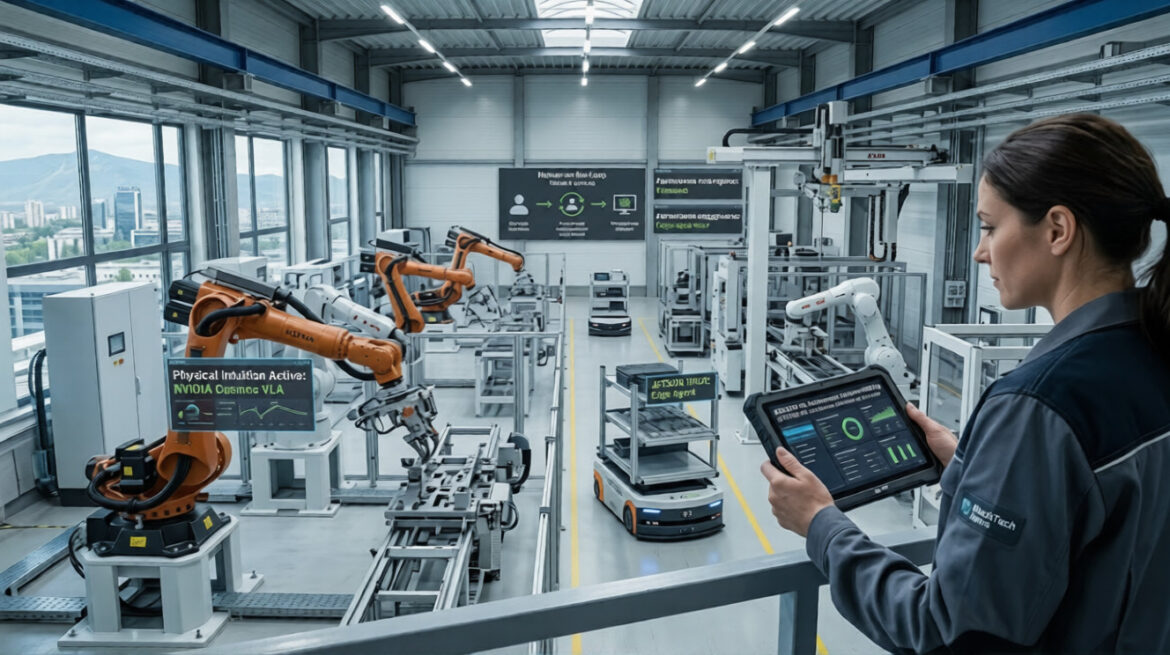
If there is a single moment when Agentic AI became real, it is the launch of NVIDIA Cosmos – the first foundation models that give robots physical intuition. Cosmos doesn’t just recognize objects. It predicts how they will fall, slide, collide, or deform. It understands physics, not pixels.
Cosmos is built around three core models:
- Cosmos Reason – plans tasks and sequences
- Cosmos Predict – forecasts physical outcomes
- Cosmos Transfer – adapts behavior to new environments without reprogramming
For the first time, a robot can adjust its grip based on material, change strategy mid‑task, or correct its trajectory based on real‑world deformation.
Jetson: The Brain at the Edge
The new Jetson modules allow Agentic AI to run locally – directly on the robot, without cloud dependency, latency, or connectivity risk. This means real‑time autonomy, higher safety, and lower operational cost.
Real Industrial Examples
- ABB uses Jetson‑powered agents for autonomous component sorting in dynamic environments.
- FANUC deploys Vision‑Language‑Action models for pick‑and‑place without preprogrammed routines.
- KUKA tests adaptive welding where the robot corrects its path based on real material deformation.
This is no longer a lab experiment. This is the factory floor – and Agentic AI is already working on it.
Business & Innovation: From “Systems of Record” to “Systems of Action”
For two decades, industry invested in ERP, MES, and SCADA – systems that record. Agentic AI transforms them into systems that act.
QAD Redzone + ChampionAI: The ERP That Works Instead of You
ChampionAI is the first operational agent embedded directly into ERP. It analyzes production data in real time, recommends actions, automates part of them, and communicates directly with frontline teams. This is ERP that doesn’t just show a problem – it solves it.
Deloitte: 4× Growth in Agentic AI Adoption
According to Deloitte’s latest report:
- 68% of manufacturers are already testing Agentic AI
- 27% are in early deployment
- a fourfold increase in adoption is already underway
The reason is simple: Agentic AI is not a tool. It is an operational manager that works 24/7.
Human‑on‑the‑Loop: The New Operating Model
This is the most important business concept today. Humans set the goals. Agentic AI manages the details. Humans approve exceptions. This is the balance between autonomy and control – and it will define the next decade of industrial operations.
The Challenges: Security, Trust, and the “Pilot Purgatory” Trap
The more autonomous AI agents become, the more complex the risks.
Managing Non‑Human Identities
Agentic AI makes decisions, communicates, executes tasks, and accesses systems. This means it must have identity, permissions, constraints, logs, and auditability. A new discipline in cybersecurity is emerging: managing autonomous digital agents.
Pilot Purgatory: The Trap of Endless Pilots
40% of Agentic AI projects will fail. The reasons are predictable: unclear business cases, weak governance, overly ambitious pilots, and lack of integration with real processes.
In early pilot deployments, Agentic AI is already delivering measurable financial impact. Production lines that integrate autonomous agents for maintenance and optimization report 18-25% reductions in unplanned downtime, while dynamic inventory management drives 10-15% lower carrying costs. In highly automated environments, autonomous order rerouting and energy‑mode optimization achieve 5-8% reductions in energy consumption within the first three months. As a result, Agentic AI pilots frequently reach full return on investment within 6-9 months, making them some of the fastest‑payback initiatives in modern manufacturing.
The Solution: Small, High‑Value Processes
The most successful deployments start with automated maintenance, dynamic inventory management, autonomous order rerouting, and energy‑mode optimization. These are quick wins that prove the value of Agentic AI without risking the entire operation.
The New Chain of Command: The Path Forward
Agentic AI is reshaping not just technology, but the power structure of industry.
Before: humans made decisions, machines executed. Now: humans set the goals, Agentic AI plans, optimizes, and executes – and machines act.
This is the new industrial hierarchy, and it is already here.
Success today belongs to the companies that integrate intelligence directly into the nervous system of the factory. Agentic AI is not the future. It is the operational reality already rewriting the industrial business model.
The question is simple: Are you ready to let your machines make decisions?