In This Article
Manufacturers are investing in MES, ERP, industrial automation and AI. But connecting these technologies into one reliable production environment remains one of the industry’s most persistent challenges.
A modern factory can have advanced robots, connected machines, real-time production monitoring and artificial intelligence tools — and still struggle to operate as an integrated system.
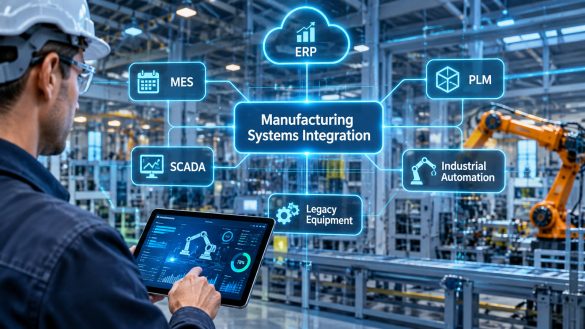
This is the central challenge of manufacturing systems integration: making different generations of industrial equipment, software platforms and business applications exchange information reliably and use it in a consistent way.
Production data may be available, but not in a format that other applications can use. Enterprise software may know what needs to be manufactured, while the production floor operates with a different view of schedules, materials and machine availability. Maintenance teams may collect equipment data that never reaches the systems responsible for production planning.
These are not necessarily problems caused by a lack of technology. In many cases, they result from technologies introduced at different times, supplied by different vendors and designed to perform separate functions.
The question facing manufacturers is therefore changing. It is no longer simply how to connect machines to software. It is how to make the entire industrial technology environment work together without compromising reliability, security or production continuity.
The Integration Gap Is Becoming Visible
The scale of the problem is reflected in research published by Rockwell Automation in July 2026.
Its Scaling MES Across the Enterprise report, based on responses from 1,560 manufacturing and industrial operations decision-makers across 17 countries, found that 93% of manufacturers had a Manufacturing Execution System (MES) in place. However, only 28% had deployed MES across their entire enterprise, while just 23% reported full integration across ERP, Product Lifecycle Management (PLM), quality and operational technology systems.
The same research found that 44% of respondents considered integration the most important factor when selecting MES technology. Meanwhile, 33% identified MES as their biggest data integration challenge.
These figures point to an important distinction: having a system installed does not mean its capabilities are fully available across an organisation.
A manufacturer may operate an effective MES platform at one facility while other production sites use different applications, older databases or separate reporting processes. Information can remain fragmented even when individual systems perform their assigned tasks correctly.
The research was commissioned by Rockwell Automation, so its findings should be considered in that context. Nevertheless, the reported gap between MES adoption and enterprise-wide integration illustrates a problem that extends beyond any single software supplier.
Why Manufacturing Systems Integration Remains Difficult
The industrial software environment has developed over several decades. Manufacturing companies rarely build their entire technology architecture from scratch.
A production facility may contain Programmable Logic Controllers (PLCs) installed many years ago, SCADA systems responsible for supervisory control, MES platforms managing production execution and ERP software handling orders, inventory and financial information.
Each layer has a different purpose.
PLCs control machines and physical processes. SCADA systems collect operational information and provide supervisory visibility. MES connects production activities with manufacturing requirements, while ERP manages broader business processes.
PLM platforms add another dimension by managing product engineering information, design changes and product lifecycle data.
In theory, these systems should exchange information continuously. In practice, their ability to communicate depends on interfaces, data structures, communication protocols and the way each system was originally implemented.
An older machine may use a communication protocol that a modern enterprise application cannot directly interpret. A production database may identify a component differently from the ERP system. A change in product design may not automatically reach the production instructions used on the factory floor.
The result is often a combination of manual data transfers, custom interfaces and additional software layers developed to bridge the gaps.
These connections can work, but they also create dependencies. When one application changes, another integration may need to be modified and tested. Over time, the architecture can become increasingly difficult to maintain.
Legacy Equipment Is Not Going Away
Replacing older industrial equipment is not always economically or operationally realistic.
A machine may still deliver reliable production performance despite having limited digital connectivity. Removing it simply because it cannot communicate natively with a modern platform may introduce unnecessary capital expenditure, installation work and production downtime.
This is particularly relevant for manufacturers operating brownfield facilities, where new technologies must coexist with existing infrastructure.
A 2026 study published in The International Journal of Advanced Manufacturing Technology examined ways to integrate legacy PLC-based systems into Industry 4.0 environments using low-code platforms. Its approach included technologies such as Node-RED, BIPES, OPC UA, Modbus and MQTT.
The research demonstrated that older equipment can be connected to newer digital environments without automatically replacing the original hardware. However, successful integration still depends on understanding the existing controllers, their communication capabilities, physical interfaces and software limitations.
This is an important point for manufacturers: digital modernisation does not always require a complete factory rebuild.
A carefully planned retrofit can extend the useful life of existing equipment while making selected operational data available to newer applications. The challenge is to determine which information should be collected, how it should be standardised and where it should be processed.
The lowest-cost connection is not necessarily the best long-term solution. An integration method that works for one machine may become difficult to maintain when extended across an entire production site.
A Real-World Example: Connecting a Brownfield Factory
The integration challenge is visible in a project involving BHS Corrugated, a manufacturer of machinery for the corrugated board industry.
A report published by INDUSTRIAL Production in August 2026 describes how the company addressed a fragmented production environment in which different applications operated in parallel and communicated directly with one another.
Changes made in one system were not necessarily visible to other applications. There was also no centralised view of process and master data.
The project introduced a central IoT platform designed to connect machines, applications and IT systems through a common data and communication layer.
A central component of the architecture was a platform called DB Manager. It was developed to provide uniform storage, structuring and distribution of production and process data.
The significance of this example is not that one platform can solve every industrial integration problem. Rather, it illustrates a different architectural approach.
Instead of maintaining numerous independent connections between individual applications, a manufacturer can introduce a shared layer through which relevant information is organised and distributed.
Such an approach can improve transparency and reduce the complexity of managing connections. However, its success still depends on data quality, system compatibility, governance and the ability to maintain the architecture as production requirements change.
The Hidden Cost of Disconnected Systems
The financial impact of disconnected industrial systems is not limited to software licences or integration projects. It can appear in several parts of manufacturing operations.
Engineering and production delays: Product design changes may need to be transferred manually into production documentation or manufacturing systems. If information is inconsistent, additional checks and corrections become necessary.
Inefficient planning: When production schedules, inventory information and machine availability are not synchronised, planners may work with incomplete or outdated information.
Maintenance limitations: Equipment data may exist within local control systems but remain unavailable to maintenance applications or analytics platforms. This restricts the ability to build a consistent view of asset performance.
Higher IT and OT maintenance requirements: Custom interfaces, protocol converters and legacy applications require specialised knowledge. When the original system integrator or equipment supplier is no longer available, maintaining those connections can become particularly difficult.
Slower digital expansion: A successful pilot project does not guarantee that the same solution can be deployed across multiple production sites. Differences in machines, networks, software versions and operating procedures can make each additional implementation more complicated.
These costs are difficult to calculate as a single figure because they are distributed across engineering, production, maintenance and IT operations. However, they can reduce the return on investments that were originally justified by expected productivity improvements.
This is why manufacturing systems integration should be treated as part of the original investment plan, not as a technical task to be addressed after new equipment and software have been purchased.
Why Industrial AI Depends on Integration
The integration challenge becomes even more important as manufacturers introduce artificial intelligence.
AI applications need access to reliable operational information. Predictive maintenance requires equipment data and historical maintenance records. Production optimisation depends on information about machine performance, quality, materials and scheduling.
If these sources remain isolated, the AI system receives only part of the operational picture.
This helps explain a potential gap between manufacturers’ AI ambitions and their digital readiness. In the same 2026 Rockwell Automation research, respondents expected 42% of manufacturing processes to be AI-supported within the following year and 54% by 2030. Yet 43% acknowledged that they were not effectively using the data they already collected.
The figures should not be interpreted as evidence that AI adoption will automatically reach those levels. They do, however, highlight an important dependency: collecting industrial data and making it usable are two different tasks.
An AI model cannot compensate for inconsistent machine identifiers, missing production records or unreliable connections between operational systems.
Before manufacturers can scale industrial AI, they need a dependable foundation for collecting, contextualising, governing and exchanging data. In that sense, integration is not simply an IT concern. It is one of the conditions that determines whether industrial AI can deliver practical value on the production floor.
Interoperability Is Becoming a Strategic Requirement
The industrial software market is responding to this challenge through several approaches.
Open communication standards, industrial middleware, edge computing and common data models are intended to make information exchange easier across different generations of equipment and software.
OPC UA, for example, provides a standardised framework for industrial communication and information modelling. MQTT is widely used for lightweight messaging in connected environments, while technologies such as MTConnect support the collection and exchange of manufacturing equipment data.
These technologies do not make every integration problem disappear. Their practical value depends on implementation, supported functionality and the quality of the information being exchanged.
Manufacturers also face an architectural decision: whether to rely primarily on a single software ecosystem or combine products from multiple suppliers.
A more consolidated environment may simplify some aspects of integration, but it can also increase dependence on one vendor. A multi-vendor architecture can offer flexibility, but requires stronger integration planning and long-term governance.
There is no universal answer. The appropriate approach depends on the factory’s existing infrastructure, operational requirements, investment capacity and future expansion plans.
What matters is that interoperability is considered from the beginning of a project. Equipment, software and data architecture decisions made today will influence how easily a factory can introduce new technologies in the future.
The Next Challenge Is Making the Factory Work as One System
Industrial digitalisation is entering a phase in which the number of connected technologies is no longer the only measure of progress.
Manufacturers need to know whether their systems can exchange meaningful information, whether operational data can support business decisions and whether new applications can be introduced without destabilising existing production.
This changes the priorities of industrial technology investment. The value of manufacturing systems integration is not measured simply by the number of interfaces created, but by whether information moves reliably between engineering, business operations and the production floor.
A factory does not become intelligent simply because it has more sensors, software platforms or AI applications. Its real digital capability depends on how effectively those technologies work together.
The next competitive advantage may therefore come less from adding another system and more from making the systems already in place function as a coherent production environment.
For manufacturers, the difficult question is no longer just what technology to buy. It is how to connect everything they already depend on and keep it working as the factory evolves.