In This Article
As factories look to automate more than production itself, KUKA’s new autonomous forklift shows how internal logistics is becoming the next frontier and why deploying a driverless truck involves far more than removing the driver.
A production line can be highly automated and still depend on a surprisingly human process: getting materials to the right place at the right time.
Pallets move between warehouses, assembly stations, quality-control areas and loading bays. Components arrive in batches, finished products need to be collected, and empty containers must return before the next production cycle begins. Much of this movement still depends on forklift operators, manually assigned tasks and coordination between different teams.
When the flow breaks down, the consequences can reach far beyond the warehouse. A manufacturing station waiting for components cannot maintain its planned output, even if its machines are fully operational.
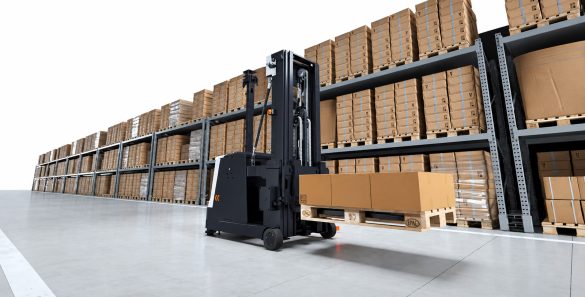
German automation company KUKA is targeting this part of the industrial system with its new KMF 1500P-CB, an autonomous counterbalance forklift designed to transport loads of up to 1,500 kilograms in manufacturing and warehouse environments.
Announced in September 2026, the machine is the first model in KUKA’s new KMF 1500P autonomous forklift family. It is scheduled to become available for orders worldwide in September, with deliveries expected to begin in December.
The significance of the launch extends beyond another driverless industrial vehicle. It reflects a wider shift in factory automation: from making individual machines more productive to coordinating the movement of materials across an entire operation.
The Problem Begins Before the Production Line
Internal logistics rarely attracts the same attention as industrial robots, CNC machines or automated assembly systems. Yet it determines whether production equipment receives the materials it needs and whether finished goods leave the factory on schedule.
In a conventional operation, forklift drivers respond to transport requests, collect pallets and move them between designated locations. This system can be flexible, particularly when production requirements change frequently.
However, it also depends on operator availability, communication and the ability to coordinate multiple transport tasks throughout a shift.
Labour shortages can make this arrangement more difficult to maintain. A company may have sufficient production capacity but struggle to keep internal transport running consistently when experienced forklift operators are unavailable.
The problem is not necessarily that manual transport is inefficient in every situation. Human-driven forklifts remain useful for irregular loads, unexpected situations and operations requiring judgment.
The challenge emerges when a factory has a high volume of repetitive, predictable movements that must be completed throughout the day.
Automating these tasks can make material delivery more consistent, reduce dependence on operator availability and allow employees to concentrate on activities that require human intervention.
The question is whether an autonomous forklift can perform these movements reliably in the actual conditions of a working factory.
Why KUKA Chose a Counterbalance Design
The KMF 1500P-CB is designed around a specific limitation found in many existing material-handling operations: not every pallet can be approached from underneath or transferred using the same equipment.
The CB designation stands for counterbalance. Unlike some automated pallet trucks that rely on a particular type of load support or transfer arrangement, a counterbalance forklift carries the load in front of the vehicle while using its own weight to maintain stability.
That configuration is important for facilities that already use enclosed transfer points, including roller conveyors.
According to KUKA, the new model can collect and transport both open and closed pallets and containers without requiring existing transfer stations to be adapted.
The vehicle has a maximum payload of 1,500 kg and can lift loads to heights of up to three metres. KUKA also highlights larger wheels intended to support stable movement over longer distances inside production and warehouse environments.
These characteristics make the machine relevant to factories where materials must move between different departments rather than simply travel along a single, dedicated route.
The counterbalance design is particularly significant because it addresses one of the practical barriers to automation: the cost and disruption of modifying existing infrastructure.
A factory that must replace its transfer stations, change its pallet formats or redesign production interfaces before installing an autonomous vehicle faces a much more complex investment than one that can introduce automation into established processes.
That does not mean every existing installation will be compatible. Pallet dimensions, load stability, floor conditions, transfer heights and operating clearances still need to be checked during system design.
But reducing the number of changes required to the surrounding equipment can make automation easier to evaluate.
From Moving Pallets to Coordinating Material Flow
The physical vehicle is only one part of an autonomous transport system.
KUKA says the KMF 1500P-CB uses its KUKA.AMR software ecosystem to integrate with material-flow processes. Its VDA 5050 interface is intended to allow connection with other fleet-management systems.
This matters because a factory rarely operates a single transport vehicle in isolation.
An automated forklift may need to receive a task when a production station finishes a batch, collect a pallet from a designated location, deliver it to a buffer area and then return to collect another load.
If several vehicles operate simultaneously, the system must coordinate their routes and tasks while accounting for congestion, blocked passages and changing production priorities.
VDA 5050 provides a standardised interface for communication between mobile robots and a central fleet-control system. Its role is to support interoperability, rather than require every vehicle to operate exclusively within one manufacturer’s fleet-management environment.
For manufacturers, this can be relevant when different generations or brands of autonomous mobile robots are expected to operate within the same facility.
However, an interface alone does not guarantee seamless integration. The plant’s warehouse management system, manufacturing execution system, transport orders and physical transfer points must still be configured to work together.
The quality of that integration can determine whether automation improves the overall operation or simply moves the coordination problem from forklift drivers to software and system engineers.
What Real Deployments Tell Us
The practical benefits of automated forklift systems are already visible in European manufacturing, although results from existing installations should not be confused with performance data for KUKA’s new model.
At the Drancy facility of French heating-equipment manufacturer elm.leblanc, two automated forklift trucks from Toyota Material Handling were introduced to handle finished products.
The vehicles collect pallets from final assembly, move them to buffer storage and return empty pallets to production. They also transport goods to the loading bay and support movements associated with quality-control operations.
According to the company’s industrial director, the installation achieved full payback in less than two years and delivered an annual productivity improvement of approximately 5%.
The company also reported more than two years without a workplace accident during the period described in the case study.
These are company-reported results from a specific installation, not independently verified figures applicable to every factory. Nevertheless, the example illustrates why automated material handling can be evaluated as an operational investment rather than simply a vehicle purchase.
The value comes from the complete transport process: fewer interruptions, more predictable movements and better coordination between production and dispatch.
For KUKA, the central question will be whether its counterbalance design can deliver similar operational benefits in facilities with demanding loads and existing transfer infrastructure.
The Safety Challenge Does Not Disappear
Removing a driver from a forklift does not remove the risks associated with moving heavy loads.
Factories and warehouses are dynamic environments. Employees cross transport routes, manually operated forklifts share space with automated vehicles, pallets may be left in unexpected locations, and production layouts can change.
An autonomous vehicle must detect obstacles, respond appropriately and operate within a safety concept designed for the specific environment.
KUKA describes the KMF 1500P-CB as having a 360-degree safety concept intended to reduce risks to employees and equipment in dynamic production and warehouse environments.
The company also states that the vehicle meets the requirements of the European Machinery Regulation, which becomes mandatory in January 2027.
For manufacturers planning an installation, however, compliance at the vehicle level is only one part of the process.
The complete system must account for traffic routes, pedestrian access, emergency procedures, transfer stations and interactions with other machines. Risk assessments, commissioning and employee training remain essential.
A facility that introduces autonomous forklifts into an area with manual traffic must establish clear operating rules and ensure that employees understand how the vehicles behave.
Safety therefore becomes a shared responsibility between the equipment supplier, system integrator and factory operator.
The technology can reduce exposure to certain risks associated with manual transport, but it cannot eliminate the need for disciplined operational management.
The Infrastructure Behind Autonomous Operation
KUKA’s new forklift uses lithium iron phosphate (LFP) batteries and conductive charging technology. The company states that the vehicle is designed to support automated operation around the clock.
That capability should not be interpreted as a guarantee of uninterrupted operation under every load and duty cycle. Battery capacity, charging time, travel distances and actual operating conditions determine how a fleet must be configured.
Manufacturers also need to consider charging locations, maintenance access and what happens when a vehicle is unavailable.
The same applies to the factory layout.
Autonomous forklifts perform most predictably when transport tasks, pickup points and delivery locations are clearly defined. Floor conditions, narrow passages, intersections and shared working areas can all affect performance.
This is why successful deployment typically begins with analysing the material flow rather than selecting a vehicle and attempting to fit it into the existing operation.
The company must identify which movements are repetitive enough to automate, how often they occur, where delays arise and what level of reliability production requires.
A facility with stable, high-volume pallet movements may have a different business case from a small workshop handling irregular loads and frequent changes in production.
In some cases, a combination of autonomous vehicles and conventional forklifts will remain more appropriate than complete automation.
The Next Step in Factory Automation
KUKA’s KMF 1500P-CB arrives as manufacturers increasingly look beyond individual production machines to the wider systems that keep factories running.
Its combination of counterbalance handling, support for different pallet types and integration with material-flow software addresses several practical considerations that influence whether autonomous transport can be introduced into existing facilities.
The company plans to expand the KMF 1500P family in the first quarter of 2027 with the KMF 1500P-PS, a pallet-stacker variant intended for open pallets and containers in more confined spaces.
The new family is therefore part of a broader effort to extend mobile automation into different internal logistics applications.
The real test will come with deployment. KUKA’s first deliveries are expected in December 2026, meaning publicly documented operating results for the new model are not yet available.
For manufacturers, the decision will ultimately depend on more than payload capacity or navigation technology. It will require a clear understanding of transport demand, infrastructure, safety, integration costs and the consequences of interruptions.
The factory of the future will not be defined only by how quickly its machines can manufacture a product. It will also depend on how reliably materials reach those machines, how efficiently finished goods move through the facility and how well people, vehicles and software work together.
That is the problem autonomous forklifts are designed to address and the reason their role in industrial automation deserves attention beyond the warehouse floor.