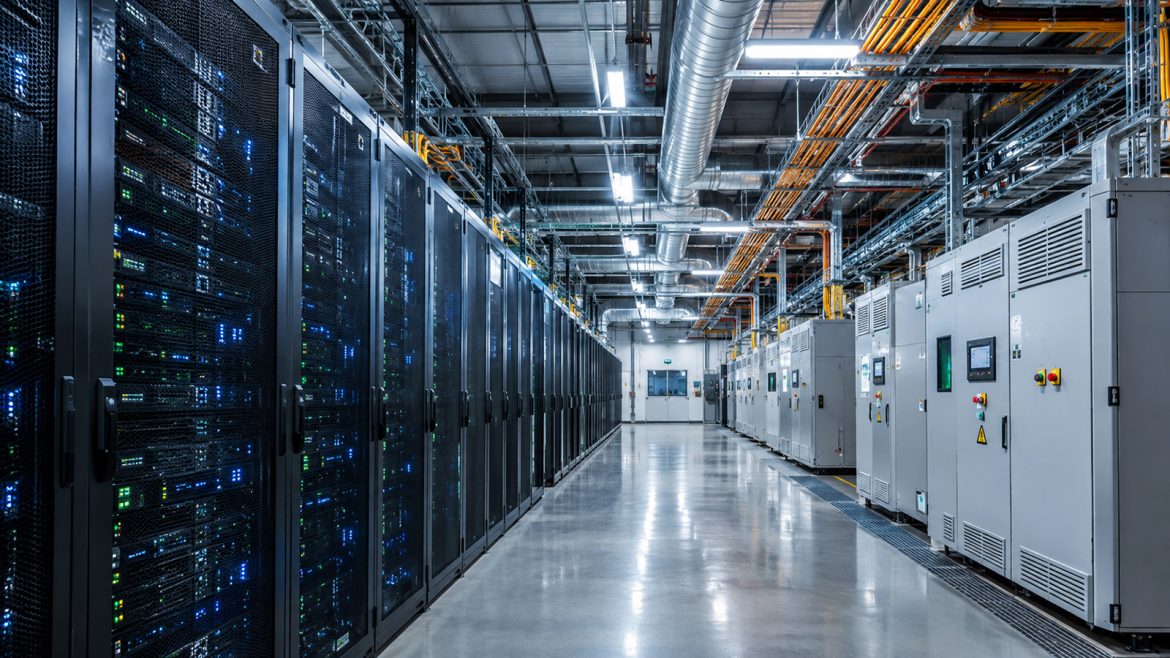
The rapid expansion of artificial intelligence is creating a new industrial market beyond chips and software. Demand for electricity, cooling and critical infrastructure is opening significant opportunities for equipment manufacturers — while exposing supply-chain constraints that could slow the entire AI build-out.
In This Article
The artificial intelligence boom is often described through the companies developing processors, cloud platforms and large language models. Yet much of the investment required to make AI commercially useful is flowing into a different part of the economy: the industrial infrastructure that keeps data centers operating.
Every new high-density AI facility requires more than servers. It needs electrical substations, transformers, switchgear, power distribution systems, backup solutions, cooling equipment and increasingly sophisticated control technologies. These systems are not peripheral components. They determine how quickly a data center can be built, how much computing capacity it can support and how reliably it can operate.
Established industrial companies are repositioning parts of their businesses to capture this demand. Manufacturers that previously served utilities, factories and commercial buildings are finding new growth opportunities in the infrastructure supporting AI computing.
The scale of the investment is substantial. The International Energy Agency estimates that the largest data center operators could spend more than $700 billion in capital expenditure during 2026, with most of that investment directed towards new facilities. At the same time, the agency warns that electricity grids and equipment supply chains are coming under increasing pressure.
The result is a new industrial growth market — one in which power availability, manufacturing capacity and engineering expertise are becoming strategic advantages.
The AI Boom Is Creating a New Industrial Market
The expansion of AI computing is changing the requirements placed on data center infrastructure.
Traditional data centers already require substantial electrical and cooling systems. AI facilities add another level of complexity because high-performance accelerators operate at much higher power densities and can create significant fluctuations in electricity demand.
This affects several interconnected industrial markets.
Electrical equipment manufacturers are seeing demand for transformers, switchgear, protection systems and power distribution equipment. Cooling specialists are developing larger and more integrated thermal management solutions. Energy storage companies are exploring technologies that can help manage rapid changes in power consumption.
The opportunity extends beyond supplying individual products. Customers increasingly need complete infrastructure architectures that connect grid power, facility distribution, backup systems, cooling and monitoring.
For industrial suppliers, this means moving further up the value chain — from selling individual components towards providing integrated systems and long-term service relationships.
McKinsey estimates that global data center investment could reach $7 trillion by 2030. This is a projection rather than a confirmed spending figure, but it illustrates the potential scale of the market and the pressure it could place on traditional industrial suppliers.
Power Equipment Is Becoming a Strategic Business Asset
Electricity availability is one of the most important constraints on data center expansion. However, generating enough electricity is only part of the challenge. It must also be transmitted, transformed, protected and distributed reliably inside the facility.
Demand is therefore growing for equipment traditionally associated with utility infrastructure and heavy electrical engineering.
A major example is GE Vernova’s agreement to acquire Trench Group from Triton Partners for approximately $9 billion. Announced on 28 October 2026, the proposed transaction would strengthen GE Vernova’s position in high-voltage grid equipment, including bushings, instrument transformers and coils.
Trench operates manufacturing facilities across Europe, North America and Asia and serves more than 800 utilities and hyperscalers. GE Vernova expects the acquisition to expand its manufacturing capabilities and complement its existing electrification businesses.
The financial projections also show why the transaction matters. Trench is expected to generate approximately $1.9 billion in revenue in 2028, with an adjusted EBITDA margin of around 36%, according to the companies’ announced expectations.
The acquisition is not yet completed. Closing is expected in late 2027, subject to regulatory approvals and other customary conditions.
The strategic significance goes beyond the purchase price. GE Vernova is securing additional access to specialised manufacturing capacity in a market where lead times, engineering expertise and the ability to deliver high-voltage equipment can influence the development of entire infrastructure projects.
Grid equipment is becoming an increasingly important part of the AI infrastructure value chain, placing established electrical engineering businesses in a stronger position to benefit from the expansion.
The Cooling Challenge Is Creating Another Growth Market
This technical overview explains why high-density AI racks are pushing air cooling to its limits and how direct-to-chip, CDUs, and immersion cooling move heat away from processors into facility-level systems.
Electricity is not the only infrastructure requirement increasing with AI adoption. The energy consumed by computing equipment ultimately becomes heat, which must be removed to maintain reliable operating conditions.
As AI servers become more powerful and rack densities increase, conventional air-cooling configurations may become insufficient for some applications. Data center operators are therefore investing in more advanced thermal management systems, including liquid cooling and integrated cooling architectures.
Manufacturers with established expertise in industrial cooling, chillers, pumps, heat exchangers and control systems are finding new opportunities.
Vertiv provides a practical example. In July 2026, the company announced an investment to expand manufacturing and testing capabilities at its Tognana campus near Padua, Italy.
The company expects to double regional chiller production capacity by the end of 2026 and complete a new large-scale testing laboratory in early 2027. The investment is intended to support growing demand for cooling systems used in high-density AI applications.
The testing facility is particularly relevant. As cooling architectures become more complex, manufacturers and customers need to validate how chillers, liquid cooling systems and other thermal components perform together under demanding operating conditions.
For suppliers, the ability to manufacture, integrate and validate complete thermal systems can become a competitive advantage when serving large infrastructure projects.
Siemens and Skeleton: Managing the Power Fluctuations of AI
Another emerging business opportunity concerns the way AI data centers consume electricity.
AI workloads can produce rapid changes in power demand as computing activity increases or decreases. When thousands of processors operate together, these fluctuations can become significant at facility scale.
This presents challenges for electrical infrastructure, particularly when operators want to increase computing capacity without waiting for major grid upgrades.
On 14 October 2026, Siemens announced a strategic investment and exclusive partnership with Skeleton Technologies, a developer and manufacturer of high-power energy storage systems specialising in supercapacitors.
The partnership aims to integrate Skeleton’s technology into Siemens’ electrical infrastructure portfolio for data centers.
Supercapacitors can absorb and release electrical energy very quickly. In this application, they are intended to help manage short-duration power fluctuations, reduce stress on electrical infrastructure and support more stable operation.
By combining its electrical infrastructure portfolio with specialised energy storage technology, Siemens is expanding its offering beyond conventional power distribution equipment and targeting a more integrated role in the AI data center market.
The partnership also illustrates how smaller technology specialists can gain access to larger industrial markets through cooperation with established equipment manufacturers.
ABB Is Preparing for a Different Power Architecture
The growing power requirements of AI facilities are also encouraging manufacturers to reconsider how electricity is distributed inside data centers.
Most existing electrical infrastructure relies on alternating current (AC). However, the increasing demand for high-density computing is driving interest in direct current (DC) architectures, which can reduce certain conversion stages and support different approaches to power distribution.
In September 2026, ABB introduced its Infinitus DC portfolio for next-generation AI data centers.
The offering brings together several elements of electrical infrastructure, including medium-voltage power systems, DC power distribution, protection technologies and cooling optimisation.
ABB positions the portfolio as an integrated source-to-rack architecture. The objective is to help data center operators manage higher power densities while improving efficiency and making infrastructure easier to scale.
The company expects the first DC-native facilities using the complete portfolio to become operational within two to three years, as key components enter production and deployment progresses.
The portfolio has been introduced, but widespread adoption of complete DC-native facilities remains a future development rather than an established market reality.
The transition also increases the importance of automation and real-time infrastructure management. Building Management Systems (BMS) and Electrical Power Monitoring Systems (EPMS) monitor and coordinate different parts of a facility’s operation. BMS platforms manage building services such as HVAC and cooling, while EPMS platforms track electrical distribution, power quality and equipment status.
Connected with industrial control systems and Data Center Infrastructure Management (DCIM) platforms, these technologies give operators a more integrated view of power consumption, cooling performance and equipment conditions. They can use operational data to coordinate cooling demand, monitor backup power systems and identify abnormal conditions before they affect availability.
For ABB, the opportunity is therefore not limited to selling a new product range. It is also about positioning its electrical engineering and automation capabilities within a market that could influence the future design of digital infrastructure.
Who Benefits From the Industrial AI Infrastructure Boom?
A look inside liquid-cooled AI data center operations, highlighting the trade-offs between power demand, cooling methods, and local infrastructure constraints.
The companies best positioned to benefit are not necessarily those with the most visible AI products. Many opportunities are emerging among manufacturers supplying essential equipment that data centers cannot operate without.
Several industrial segments stand to gain:
- Electrical equipment manufacturers can benefit from demand for transformers, switchgear, power distribution and protection systems.
- Cooling technology suppliers can expand through chillers, liquid cooling, thermal management and integrated testing services.
- Energy storage developers can address power fluctuations, backup requirements and facility resilience.
- Automation and control companies can provide monitoring, optimisation and integration across increasingly complex infrastructure.
- Specialised component manufacturers can become strategically important suppliers as demand grows for equipment with long manufacturing lead times.
However, higher demand does not automatically translate into higher profits.
Manufacturers must invest in production capacity, skilled personnel, engineering resources and supply-chain resilience. Expanding too slowly can mean losing customers, while investing too aggressively creates the risk of excess capacity if data center projects are delayed or cancelled.
The market also depends on factors outside the control of equipment manufacturers. Grid connection queues, permitting, electricity prices, financing conditions and local infrastructure limitations can all affect when new facilities become operational.
The IEA has highlighted these constraints, including the pressure that data center expansion is placing on electricity networks and supply chains for critical equipment.
The Next Industrial Growth Market May Be Behind the Servers
The AI infrastructure boom is creating a shift in industrial demand that extends well beyond the technology companies developing computing platforms.
GE Vernova’s proposed acquisition of Trench, Siemens’ partnership with Skeleton Technologies, Vertiv’s manufacturing expansion and ABB’s new DC portfolio illustrate different ways established industrial companies are responding.
Some are securing additional manufacturing capacity. Others are adding specialised technologies, expanding production or developing integrated infrastructure solutions.
Their strategies are different, but the underlying business opportunity is similar: AI growth requires a much larger and more sophisticated industrial support system.
For manufacturers, this could become one of the most important sources of demand over the coming years. The companies that can deliver reliable power equipment, advanced cooling, energy management and integrated infrastructure will play a critical role in determining how quickly the AI economy can expand.
The next stage of the AI race may therefore be decided not only by who builds the most powerful chips, but also by who can manufacture and deliver the industrial systems that keep them running.